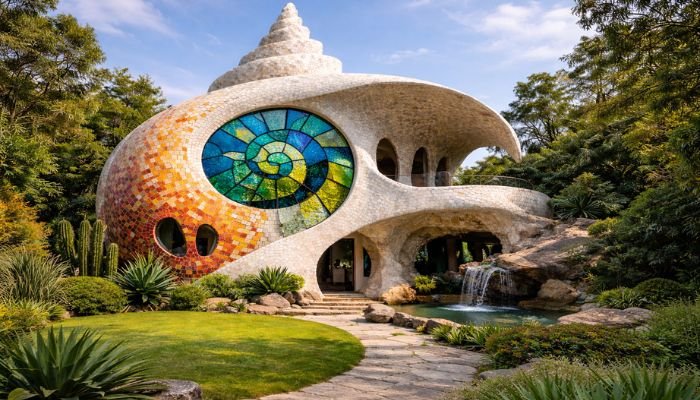
In the hills of Naucalpan, just northwest of Mexico City, stands one of the most extraordinary residential designs of the modern era — the Nautilus House. Designed by renowned Mexican architect Javier Senosiain, this shell-shaped home challenges everything we assume a house should look like.
Completed in 2007, the Nautilus House is not merely inspired by a seashell — it functions like one. From its logarithmic spiral geometry to its ferrocement shell structure, the home behaves as a continuous organism rather than a collection of rooms.
More than a visual icon, this project represents a profound exploration of organic architecture, spatial psychology, environmental adaptation, and structural innovation. In this comprehensive architectural case study, we examine its concept, plans, interior layout, construction system, structural logic, and lasting relevance in 2026.
Editorial Note: Some images featured in this article are architectural visualizations created for educational and analytical purposes, inspired by the design of the Nautilus House in Mexico.

Project Overview & Site Context
The Nautilus House is located in Naucalpan, in the State of Mexico. The site presented considerable constraints: three sides were bordered by tall neighboring structures, limiting openness and sunlight. Only the western side offered expansive mountain views.
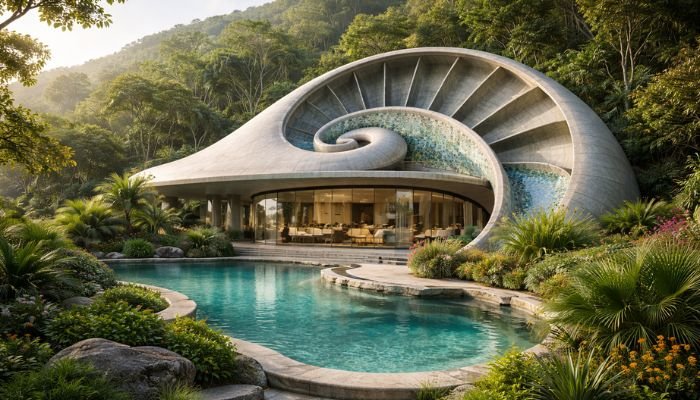
Rather than impose a rigid rectangular plan onto the land, Senosiain allowed the terrain to influence the design. The house was positioned toward the back of the site, leaving pedestrian and vehicle access at the front.
Key Specifications
- Architect: Javier Senosiain
- Location: Naucalpan, State of Mexico
- Completion Year: 2007
- Built Area: 330 m²
- Typology: Private Residential House
- Structural System: Ferrocement shell
- Design Language: Organic architecture
Unlike traditional homes organized through stacked rectangular floors, the Nautilus House follows a spiral logic. Circulation flows continuously, without sharp corners or parallel walls.
The Philosophy of Organic Architecture
To understand the Nautilus House fully, we must examine its philosophical foundation. Organic architecture seeks harmony between human habitation and the natural world. Rather than copying nature literally, it interprets its principles — growth, adaptation, curvature, and fluidity.
Senosiain has long been associated with this architectural approach. His work explores how humans instinctively respond to curved, cave-like, or womb-like spaces. In the Nautilus House, the inspiration came from the nautilus shell — a natural example of mathematical beauty and structural efficiency.
The logarithmic spiral found in the shell allows gradual expansion without altering proportions. This geometry became the organizing principle of the home.
The result is not symbolic architecture, but structural biomimicry — a house that grows spatially the way a shell grows physically.
Design Concept: The Spiral as Structure and Space
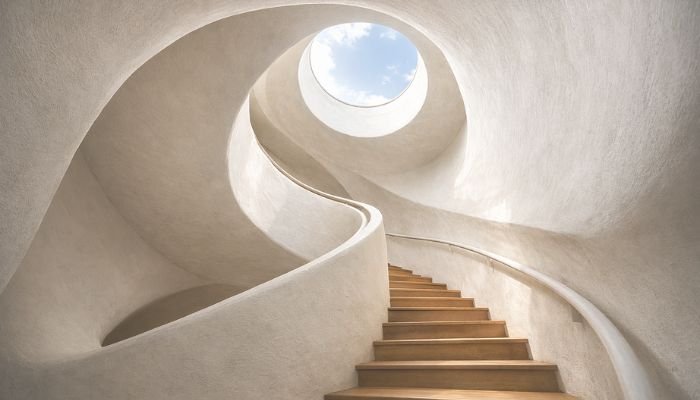
The spiral form defines everything:
- Circulation paths
- Structural stability
- Light penetration
- Ventilation flow
- Interior zoning
Rather than dividing the house into separate boxes, the spiral integrates all spaces within a continuous shell. Movement through the home feels like a natural progression — ascending gently through levels without abrupt transitions.
This creates what can be described as a “fluid spatial experience.” There are no rigid corridors; instead, one space flows into another organically.
The metaphor is powerful: living inside the Nautilus House feels like inhabiting a protective shell — an interior world distinct from the outside urban environment.
Exterior Architecture & Structural Logic
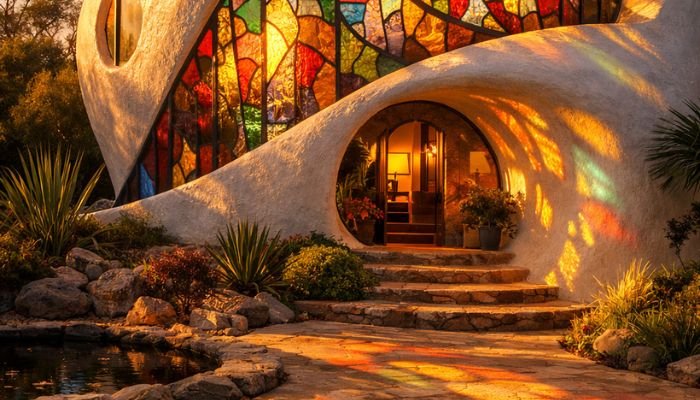
At first glance, the exterior resembles a giant seashell embedded in the landscape. Mosaic patterns on the façade mimic natural shell growth lines, while large stained-glass openings punctuate the curved surfaces.
But beyond aesthetics, the exterior is structurally sophisticated.

Double Curvature Strength
The house operates structurally as a continuous shell. Its double curvature distributes loads evenly across the surface, increasing rigidity without requiring heavy structural members.
Unlike traditional beam-and-column systems, the Nautilus House does not rely on internal supports. The shell itself carries the load, similar to an eggshell or dome.
Thickness and Material Efficiency
The ferrocement shell is typically only 4–5 cm thick. Despite its thinness, curvature provides immense strength. This efficiency reduces material usage while maintaining stability.
In structural engineering terms, curvature increases moment of inertia and prevents buckling. The spiral geometry reinforces itself as it ascends.
Interior Spatial Experience
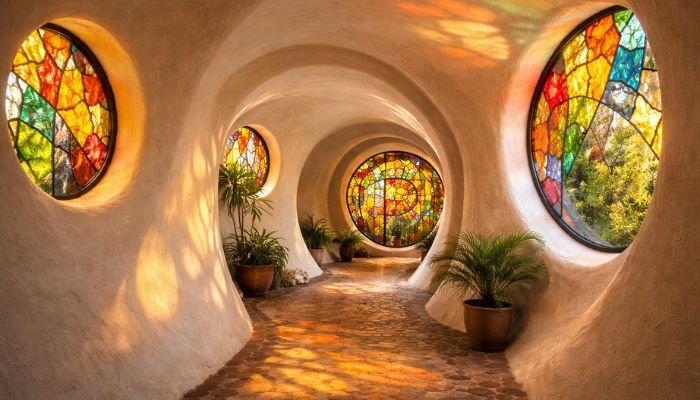
Entering the Nautilus House is a sensory experience. Access occurs through a large stained-glass entry window that filters colored light into the space.
Living Room & Interior Garden
The primary social space opens toward an interior garden, blurring the boundary between indoor and outdoor environments. Curved walls and natural light create a floating sensation above vegetation.
Dining Area Emerging from Structure
Rather than placing furniture within the room, certain elements are integrated into the structure itself. The dining table appears to emerge directly from the wall, reinforcing continuity of form.
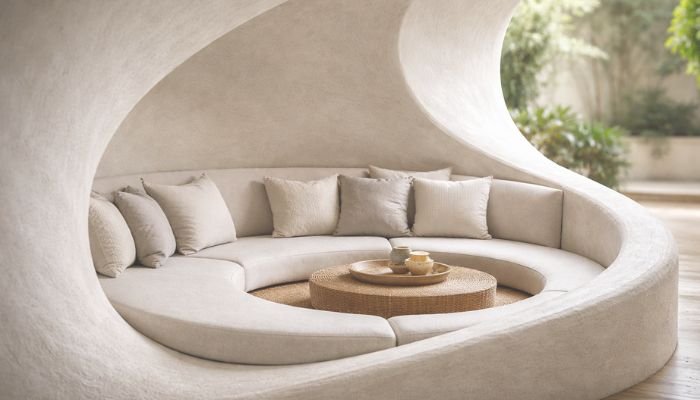
Television Room in the “Belly”
The bulging section of the shell houses a television room — a protective chamber within the spiral’s curve.
Private Zones
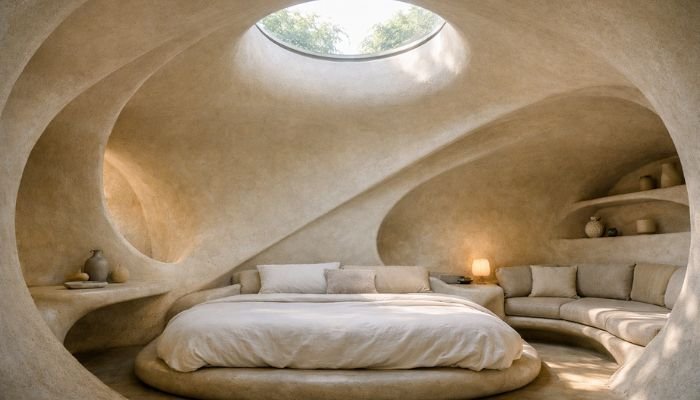
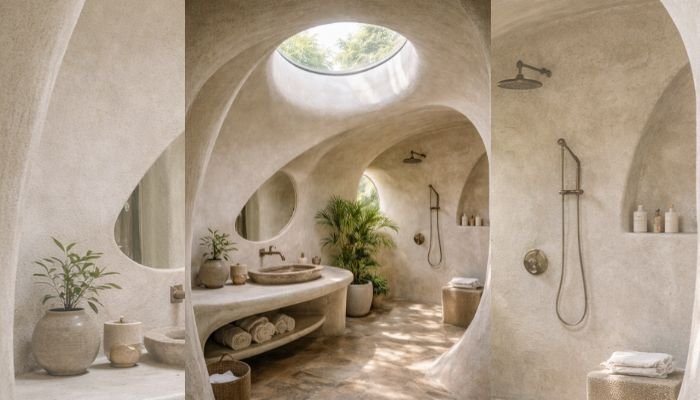
Bedrooms, bathrooms, and service areas wrap around the rear portion of the spiral. These spaces remain private while still benefiting from the organic geometry.
Psychological Impact of Curved Architecture
One of the most overlooked aspects of the Nautilus House is its psychological effect.
Humans have lived in caves for most of evolutionary history. Curved, enveloping spaces trigger a sense of safety and shelter. Sharp angles, by contrast, can feel rigid or confrontational.
The Nautilus House leverages this instinctive response. Continuous curves eliminate visual tension. Movement feels intuitive, almost subconscious.
Natural light filtered through colored glass enhances this experience, creating shifting atmospheres throughout the day.
This makes the house not only architecturally innovative but emotionally engaging.
Natural Lighting & Passive Ventilation System

The house incorporates an intelligent environmental strategy.
Underground Air Ducts
Two underground ducts regulate air temperature naturally:
- In summer, incoming air cools underground before entering the home.
- In winter, air warms as it passes through the earth.
The spiral form pushes warm air upward and outward through higher openings, creating passive airflow without heavy mechanical systems.
Skylights & Stained Glass
Circular skylights punctuate the shell, allowing daylight to enter from above. Colored glass windows create dynamic interior lighting effects that change throughout the day.
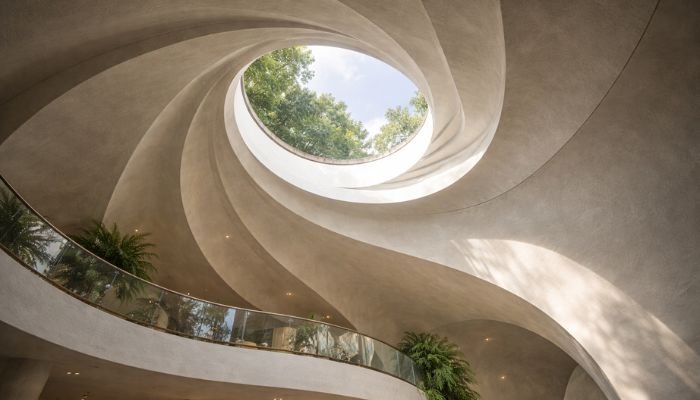
This reduces artificial lighting needs and enhances ambiance.
Construction Process & Ferrocement System
The construction method was crucial to achieving organic form.
What Is Ferrocement?
Ferrocement consists of layers of steel mesh embedded in cement mortar. It is lightweight, moldable, and capable of forming complex curves.
Unlike conventional concrete poured into rigid molds, ferrocement can be shaped gradually by hand and layered carefully.
Construction Phases
- Steel reinforcement mesh shaped along spiral geometry
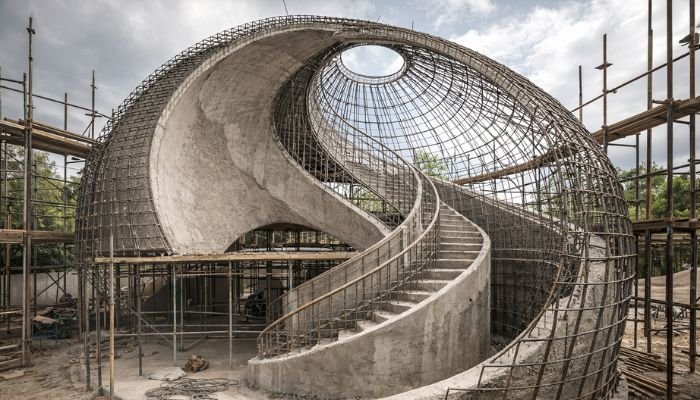
- Multiple layers of mortar applied
- Surface sculpted and smoothed
- Waterproofing and finishing treatments
- Mosaic application on exterior
The process required precision, especially at transitions where curvature changes direction.
The result is a seamless shell with no visible structural breaks.
Floor Plans & Spatial Organization
The Nautilus House floor plans do not follow conventional grids.
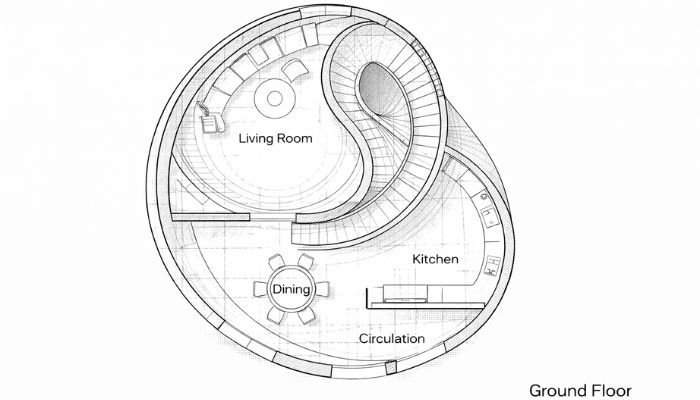
Ground Floor
Primary social areas and interior garden integration.
First Level
Transitional spaces, circulation path, and media room.
Upper Level
Study and viewing area overlooking landscape.
Roof Plan & Section
Architectural sections reveal how spiral geometry maintains structural integrity across levels.
These drawings are essential to understanding how the home functions structurally.
Structural Engineering Breakdown
From an engineering perspective, the Nautilus House operates like a continuous dome extended into a spiral.
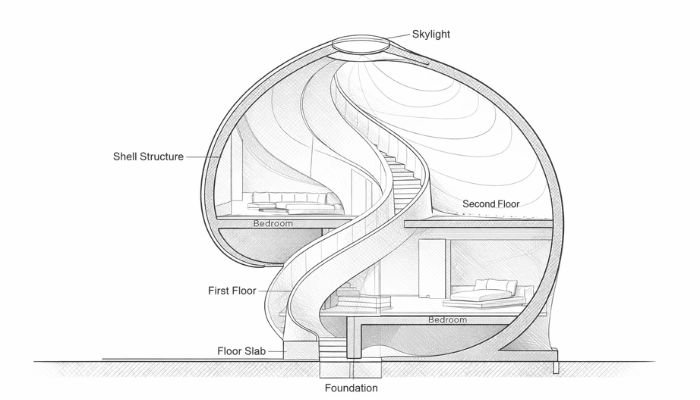
Key principles:
- Load distributed across curved surfaces
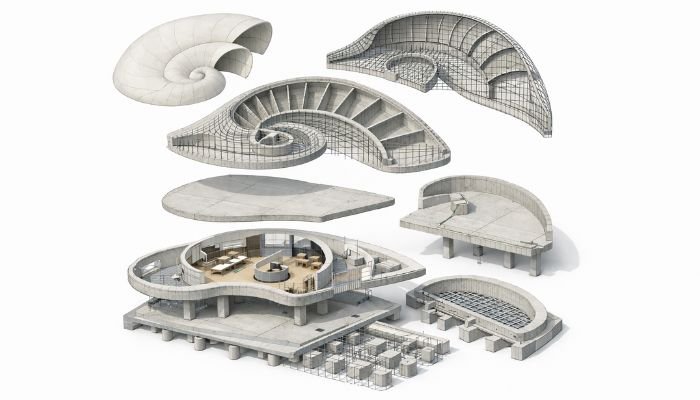
- Compression forces flow along shell geometry
- Minimal tensile stress due to curvature
- Reduced reliance on internal columns
Compared to a conventional rectangular home:
| Conventional Home | Nautilus House |
| Beam-column system | Continuous shell |
| Heavy structural members | Thin ferrocement |
| Flat slab loads | Curved load distribution |
| High material consumption | Efficient geometry |
The house demonstrates how geometry can replace mass.
Comparison with Traditional Residential Architecture
Traditional homes are built using orthogonal geometry: vertical walls, flat ceilings, rectangular rooms.
The Nautilus House rejects this system.
Differences
- No 90-degree corners
- No parallel walls
- Integrated furniture
- Organic flow
- Structural shell envelope
Traditional homes compartmentalize space. The Nautilus House unifies it.
This makes it both visually and experientially different.
Sustainability & Relevance in 2026
As sustainable architecture becomes increasingly urgent, the Nautilus House appears ahead of its time.
Why It Still Matters
- Passive ventilation
- Reduced material thickness
- Biomimicry principles
- Integrated natural light
- Psychological well-being focus
In 2026, architects continue to explore organic forms inspired by nature. The Nautilus House remains one of the earliest residential examples to apply these ideas at full scale.
Frequently Asked Questions
1. Where is the Nautilus House located?
In Naucalpan, State of Mexico.
2. Who designed the Nautilus House?
It was designed by Javier Senosiain.
3. When was it completed?
2007.
4. What material was used to build it?
Ferrocement shell construction.
5. Is the Nautilus House open to the public?
It is a private residence; access is limited.
Conclusion
The Nautilus House is more than a seashell-shaped home. It is a demonstration of how architecture can evolve beyond rigid geometry and reconnect with natural principles.
Through spiral form, ferrocement construction, passive environmental systems, and fluid interior space, Javier Senosiain created a house that behaves like a living organism.
Nearly two decades after its completion, the Nautilus House remains one of Mexico’s most iconic examples of organic architecture — not because of its unusual shape, but because of the intelligence behind it.
It is proof that when architecture follows nature’s logic, beauty and efficiency naturally align.