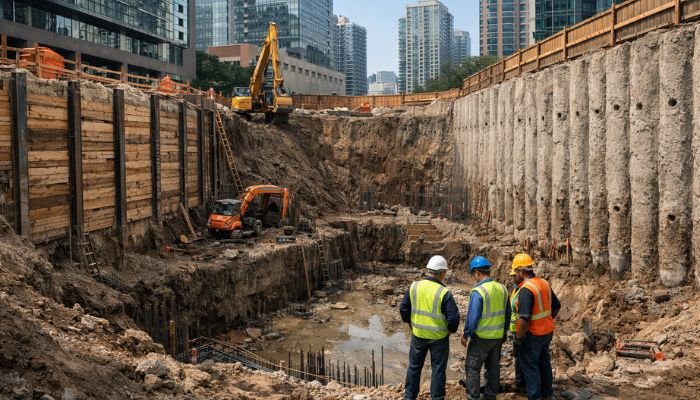
When soil is excavated or a structural element loses lateral support, collapse becomes a serious safety and financial risk. That’s where shoring becomes critical.
Shoring walls are temporary (and sometimes permanent) structural systems designed to stabilize soil, protect nearby structures, and prevent structural failure during construction. Whether you’re building a basement, installing underground utilities, constructing a metro tunnel, or working in dense urban areas, choosing the right type of shoring directly impacts safety, cost, and timeline.
The five main types of shoring used in construction are soldier pile, secant pile, contiguous pile, sheet pile, and diaphragm walls. Each system is selected based on soil type, groundwater level, excavation depth, and project requirements.
In this complete 2026 guide, you’ll learn:
- What shoring is in construction
- The difference between shoring and retaining walls
- The 5 main types of shoring walls
- The 3 most common types of shoring
- Soil-based selection guidance
- Installation steps
- Cost comparisons
- OSHA safety updates
- FAQs optimized for featured snippets
Let’s begin with the fundamentals.
What Is Shoring in Construction?
Shoring is the installation of a temporary structural support system to stabilize soil, walls, or adjacent structures during excavation or repair.
A shoring wall prevents soil movement and structural collapse when natural lateral support is removed during excavation.
When Is Shoring Required?
In the United States, the Occupational Safety and Health Administration requires protective systems for most excavations deeper than 5 feet unless the excavation is made entirely in stable rock.
Shoring is commonly required for:
- Basement excavation
- Trench construction
- Tunnel construction
- Foundation repair
- Demolition adjacent to existing buildings
Shoring vs. Retaining Walls: What’s the Difference?
Although often confused, they serve different purposes.
| Shoring Walls | Retaining Walls |
| Usually temporary | Permanent structure |
| Installed during construction | Part of final structure |
| Prevent soil collapse during excavation | Hold soil long-term |
| May be removed later | Remain permanently |
Some systems, like diaphragm walls, can serve both temporary and permanent purposes.
Why Shoring Walls Are Critical in Construction
1. Worker Safety
Excavation collapses are among the deadliest construction hazards.
2. Protection of Adjacent Structures
In urban environments, even minor soil displacement can damage nearby foundations.
3. Groundwater Control
Certain shoring systems reduce water intrusion.
4. Enabling Deep Excavations
Basements exceeding 10 meters require engineered earth retention systems.
5. Regulatory Compliance
Failing to install proper trench shoring can result in OSHA penalties and project shutdowns.
5 Main Types of Shoring Used in Construction
1. Soldier Pile (H or I-Beam) Shoring
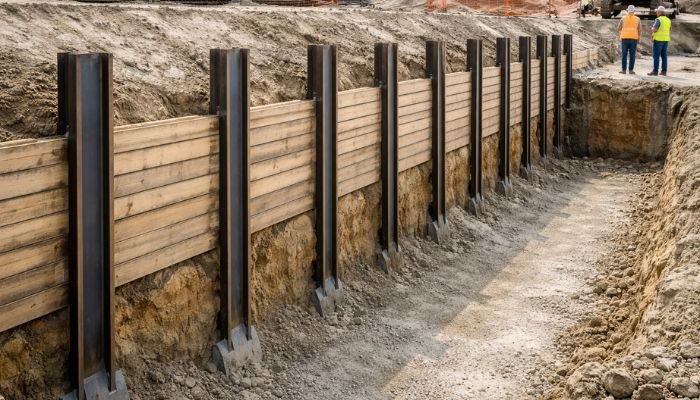
Also known as H-beam shoring, this is one of the most common excavation support systems.
How It Works
- Steel H or I beams are drilled or driven into the ground.
- Excavation proceeds in stages.
- Timber lagging or precast panels are installed between beams.
Installation Steps
- Drill or drive steel piles at calculated spacing.
- Excavate soil in controlled lifts.
- Insert lagging between piles.
- Add tiebacks if required for additional support.
Best Used For
- Excavations 1.2m–6m deep
- Urban construction
- Moderate soil conditions
Advantages
- Cost-effective
- Quick installation
- Flexible for irregular sites
Disadvantages
- Limited groundwater resistance
- May require tiebacks
Typical Cost (2026 Estimates)
$50–$120 per square meter (varies by region and depth)
Real-World Example
Soldier pile systems are widely used in mid-rise commercial basement projects across major U.S. cities due to cost efficiency and speed.
2. Secant Pile Shoring
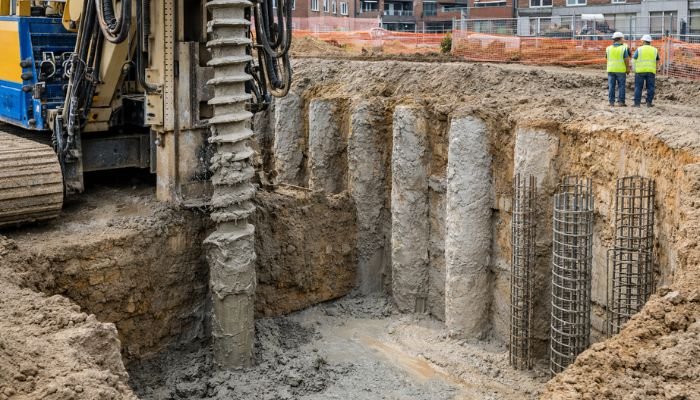
Secant piles create a continuous reinforced concrete wall by overlapping drilled piles.
How It Works
- Primary (unreinforced) piles drilled first
- Secondary (reinforced) piles drilled overlapping primaries
- Forms a rigid, watertight barrier
Installation Steps
- Drill primary piles.
- Allow partial curing.
- Drill intersecting reinforced piles.
- Install anchors or internal bracing if required.
Best Used For
- Limited space construction
- High groundwater areas
- Deep excavations near structures
Advantages
- Strong and rigid
- Better water control
- Suitable for deep basements
Disadvantages
- Higher cost
- Requires precision drilling
Typical Cost
$150–$300 per square meter
Case Study Example
Secant pile walls are commonly used in deep urban subway station construction where groundwater control is critical.
3. Contiguous (Tangent) Pile Shoring
Also known as tangent piles, this system consists of closely spaced concrete piles that touch but do not overlap.
How It Works
- Drilled concrete piles installed side by side
- Minimal gaps between piles
Installation Steps
- Mark pile layout.
- Drill and pour reinforced concrete piles.
- Install bracing if required.
Best Used For
- Clay soils
- Low groundwater sites
- Moderate excavation depths
Advantages
- More economical than secant piles
- Good structural performance
Disadvantages
- Not watertight
- Allows some seepage
Typical Cost
$100–$200 per square meter
4. Sheet Pile Shoring Walls
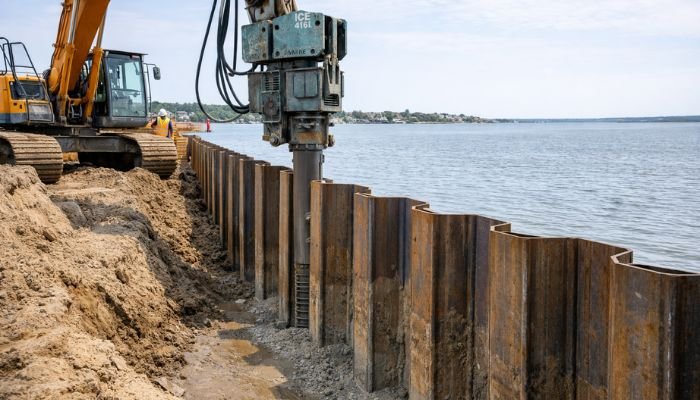
Sheet piles are interlocking steel sections driven into the soil.
How It Works
- Steel Z or U sections interlock
- Driven using vibratory hammer
- Creates continuous barrier
Installation Steps
- Position guide frame.
- Drive first sheet.
- Interlock successive sheets.
- Cut to required height.
Best Used For
- Waterfront construction
- Cofferdams
- Ports and marine works
Advantages
- Good water resistance
- Reusable materials
- Fast installation
Disadvantages
- Noise and vibration
- Less suitable in rocky soil
Sustainability Note (2026 Trend)
Many contractors now use recycled steel sheet piles to reduce embodied carbon.
5. Diaphragm Walls
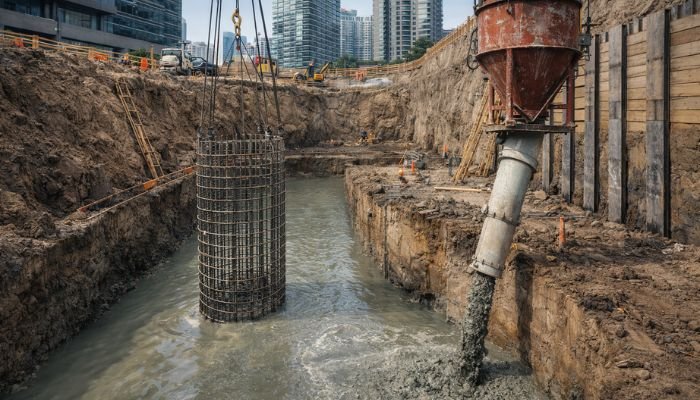
Diaphragm walls are deep reinforced concrete walls built using slurry trench methods.
How It Works
- Slurry stabilizes trench walls
- Reinforcement cage inserted
- Concrete poured from bottom up
Installation Steps
- Excavate trench with slurry support.
- Place reinforcement cage.
- Pour tremie concrete.
- Cure and connect panels.
Best Used For
- Deep basements (10m+)
- Tunnels
- High groundwater zones
Advantages
- Extremely strong
- Excellent water resistance
- Can serve as permanent wall
Disadvantages
- High cost
- Specialized equipment required
Typical Cost
$300+ per square meter
Real-World Example
Major underground transit expansions worldwide rely on diaphragm walls for depths exceeding 30 meters.
Soil Type vs. Best Shoring System
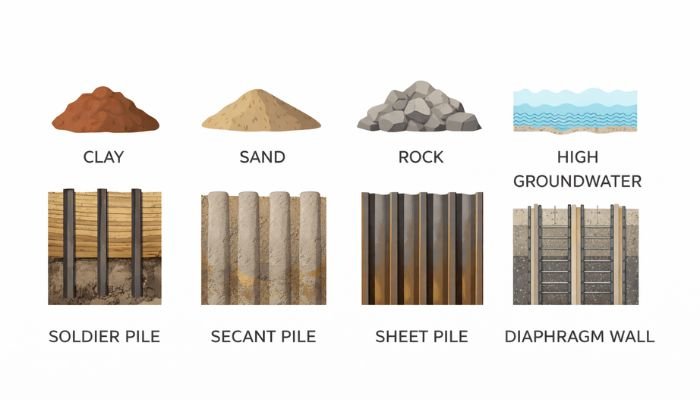
| Soil Type | Best Shoring Types | Why |
| Clay | Contiguous piles | Low permeability |
| Sand / Granular | Secant or sheet piles | High seepage risk |
| Rock | Soldier piles | Easy drilling |
| High Groundwater | Secant or diaphragm walls | Watertight performance |
The 3 Most Common Types of Shoring
For quick reference, the three most widely used systems are:
- Soldier Pile Shoring
- Secant Pile Shoring
- Contiguous Pile Shoring
These cover most commercial excavation needs.
Cost Comparison of Shoring Walls (2026)
| Shoring Type | Cost Range (Per m²) | Best For |
| Soldier Pile | $50–$120 | Mid-depth, dry soil |
| Contiguous Pile | $100–$200 | Clay, moderate depth |
| Secant Pile | $150–$300 | High groundwater |
| Sheet Pile | $120–$250 | Waterfront |
| Diaphragm Wall | $300+ | Deep basements |
Costs vary based on region, depth, soil, and project complexity.
How to Choose the Right Shoring Wall System
Consider These Factors:
- Soil classification
- Groundwater level
- Excavation depth
- Adjacent building loads
- Project timeline
- Budget
A professional geotechnical investigation is mandatory before finalizing any earth retention system.
Temporary vs. Permanent Shoring Walls
Most systems are temporary. However:
- Diaphragm walls often become permanent basement walls.
- Secant piles can be integrated into final structure.
Using permanent shoring may reduce long-term structural costs.
Common Mistakes in Wall Shoring Projects
- Ignoring surcharge loads
- Poor groundwater assessment
- Underestimating lateral earth pressure
- Inadequate tieback installation
- Skipping soil investigation
Engineering oversight is essential.
Frequently Asked Questions (Voice-Search Optimized)
1. What are the main types of shoring?
The five main types are soldier pile, secant pile, contiguous pile, sheet pile, and diaphragm walls.
2. What are the 3 types of shoring most commonly used?
Soldier pile, secant pile, and contiguous pile shoring are the most common systems in commercial construction.
3. What shoring system is best for a 10-meter basement?
Secant pile or diaphragm walls are typically recommended for deep basements with groundwater presence.
4. How much does soldier pile shoring cost per meter?
Costs typically range between $50 and $120 per square meter depending on soil and region.
5. What is the difference between trench shoring and wall shoring?
Trench shoring protects narrow excavations, while wall shoring supports large excavation faces.
Final Thoughts: Choosing the Right Type of Shoring in 2026
Selecting the correct type of shoring is one of the most important decisions in excavation planning. The wrong choice can lead to structural failure, cost overruns, and safety hazards.
From economical soldier pile systems to high-performance diaphragm walls for deep excavations, each method has its place.
As construction projects grow more complex in 2026, integrating geotechnical analysis, sustainable materials, and regulatory compliance is no longer optional—it’s essential.
If you’re planning a project, consult a qualified structural and geotechnical engineer to determine the safest and most cost-effective shoring wall solution for your site.
For more such informational articles, visit Beautifulhousetips.com.