
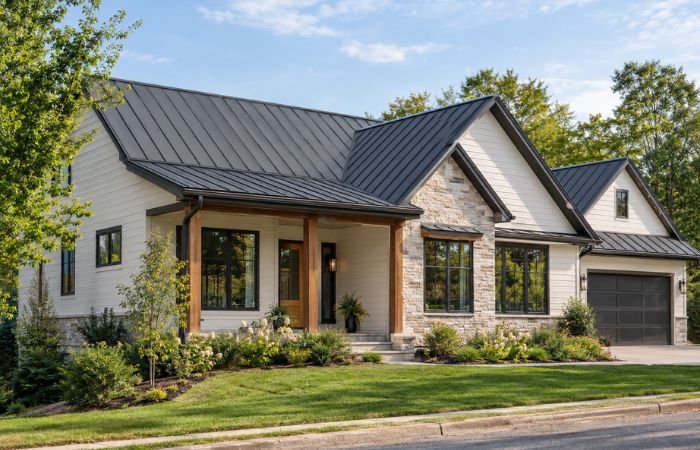
A charcoal roof can look almost black beside pale siding and noticeably softer above dark brick. Put that same colour on a deeply ribbed panel, and the shadows change its appearance again.
That is why choosing a metal roof involves more than finding a favourite square on a colour chart. The panel shape, surface finish and surrounding materials all influence what you see from the street.
Long-term appearance needs consideration too. The coating, roof details and installation affect how the finished surface weathers. A good choice brings those practical questions into the design conversation before the panels are ordered.
Start With the Parts of the House That Will Stay
Look at the exterior materials you are unlikely to replace.
Brick, stone and permanent cladding should carry more weight than a front door that can easily be repainted. Examine their undertones rather than relying on broad labels such as brown, grey or cream.
A grey stone facade may contain warm beige flecks. Red brick can lean towards orange, purple or brown. Those differences can explain why one roof sample feels comfortable while another seems disconnected.
Choose a small group of colours that work with the existing materials, then compare them outdoors.
Think about future plans as well. If new siding is already scheduled, select the roof with that complete palette in mind. Otherwise, choose for the house you have rather than an uncertain exterior makeover.
Consider How Much Roof You Actually See
Roof shape changes the importance of colour.
On a steep roof, the covering may occupy a large part of the front elevation. A strong colour can become the dominant feature. On a lower roof behind a prominent fascia, the panel edges and trim may attract more attention than the main surface.
Walk across the street and look from the approaches visitors normally use. Include views of dormers, porch roofs and attached garages.
A simple house may accommodate a more expressive roof colour. An exterior already combining several materials might benefit from a quieter choice.
This is a design judgement rather than a fixed rule. The useful question is whether the roof supports the whole composition or competes with every other feature.
Match the Profile to the House’s Character
The profile is the shape formed into the metal panel. It determines the rhythm of ribs, seams and shadows across the roof.
Standing seam creates pronounced lines running along the roof slope. It can suit contemporary architecture, but restrained versions also work well with traditional forms.
Corrugated panels introduce a more frequent, rounded pattern. They can complement rural houses, cottages and designs that deliberately use an agricultural reference.
Other ribbed profiles have flatter areas between raised ribs, producing a different balance of texture and shadow.
When comparing metal roofing panels and profiles, view each option in the proposed colour. A sample in bright bare metal will not show precisely how a dark painted version reads.
Also check the exact product’s suitability. A panel offered for siding, soffits or liners should not be assumed suitable for roofing simply because its appearance appeals.
Panel Width and Surface Texture Change the Result
Even within standing seam, the roof can look quite different.
Closer seam spacing produces a busier rhythm. Wider flat areas create a broader, more uninterrupted surface. Small ribs or striations add texture without changing the main seam arrangement.
Those details also affect reflections. Flat metal can show visible waviness, commonly called oil canning. It is often an appearance concern rather than evidence of a failed roof.
Panel width, material thickness, manufacturing and installation can influence its visibility. Striations may help break up reflections, but they do not guarantee a perfectly flat-looking surface.
Ask to see an installed example with similar panel dimensions. View it in direct sunlight and from an angle, when reflections may be more revealing.
A small flat colour chip cannot demonstrate the appearance of a long finished panel.
Approve Physical Samples in Daylight
Online photographs help narrow the search, but screens alter colour. Printed charts have limitations too.
Obtain actual coated-metal samples before giving final approval. Place them beside the brick or siding and examine them outdoors in sun and shade.
If possible, view the sample at an angle approaching the roof’s intended position. Metal laid flat on a kitchen table may reflect light differently from the finished installation.
Compare gloss levels as well. A muted finish and a shinier finish in a similar colour can create different impressions.
Keep the approved sample and record the manufacturer’s colour name, code and coating system. Names such as graphite, slate and charcoal are not standardised across suppliers.
For a large order, confirm any requirements concerning material batches and the orientation of special-effect finishes.
Ask What Protects the Colour
The colour name says little about the coating beneath it.
Factory-painted metal roofing commonly uses coating systems such as silicone-modified polyester, known as SMP, or polyvinylidene fluoride, known as PVDF. Their performance depends on the complete formulation and product specification.
Fading describes a change in colour. Chalking is the development of a powdery residue as the coating weathers. Both can affect appearance without immediately making the roof leak.
Ask for the coating details and written warranty for the actual product. Check what the warranty says about colour change, chalking and film integrity, including exclusions and any differences between colours.
A lengthy headline warranty does not mean every visible change is covered for that entire period.
Keep finish performance separate from installation workmanship. The coating manufacturer and installer may have different responsibilities.
Let the Roof Requirements Narrow the Choices
An attractive profile still has to work on the building.
Minimum roof slope varies between panel systems. A concealed-fastener product is not automatically suitable for every low-slope roof, and different seam designs can have different requirements.
Ask the installer to confirm the exact system against the roof geometry and manufacturer’s instructions.
Attachment matters too. Exposed-fastener systems place fasteners through the panel face. Concealed-fastener systems hide the primary attachments within the assembly. That difference affects appearance, detailing and maintenance considerations.
Long panels also need installation details that accommodate thermal movement.
These decisions should be settled before treating the remaining choice as purely decorative. A profile that does not suit the roof is not a worthwhile compromise for achieving a preferred look.
Finish the Design at the Edges
Trim can make a carefully selected roof feel complete—or unexpectedly awkward.
Review the ridge caps, valleys, eaves and gable edges. Decide which elements should match and where a contrasting colour is intentional.
Include gutters, fascia and visible accessories in the discussion. A dark roof beside bright white trim creates a different outline from a coordinated dark edge.
Roof penetrations deserve thought as well. Ask how vents and other necessary components will be positioned and finished within the system’s requirements.
Where snow retention is needed, coordinate its appearance and attachment early. Adding it later can interrupt the intended composition and complicate detailing.
Request a clear description of the complete visible roof rather than approving the main panels and leaving every accessory undecided.
Choose for Maintenance as Well as the First Photograph
A roof’s appearance depends partly on what happens after installation.
Branches can scrape finishes, debris can collect in valleys and incompatible materials can contribute to corrosion. Cleaning and maintenance should follow the roof manufacturer’s guidance.
Ask how the installer will handle scratches, cutting debris and damaged panels before handover. Touch-up products have limitations and should not be assumed to make every mark disappear.
If future solar panels or other roof equipment are planned, discuss attachment compatibility now.
Colour also influences solar heat absorption, but energy performance cannot be predicted from the colour name alone. Coating properties, climate and the rest of the roof assembly matter.
Choose a roof that works with the house, then keep its product records. Knowing the exact panel and finish makes future maintenance and replacement decisions considerably easier.
FAQs About Metal Roof Colours and Profiles
Which metal roof colour is least likely to look dated?
Begin with the house’s permanent materials. A restrained grey, brown or muted green can work well when its undertones suit the exterior. Black is not automatically timeless on every home, and a distinctive colour can remain convincing when it fits the architecture.
Will a dark metal roof make upstairs rooms too hot?
Roof colour affects solar absorption, but it is only part of the picture. Some darker coatings use reflective pigments, while insulation and air sealing affect heat transfer into the rooms. Compare the product’s published performance rather than assuming all dark roofs behave alike.
Is standing seam always the best-looking option?
Its clean lines appeal to many homeowners, but the right profile depends on the house. Corrugated or other ribbed panels may suit a cottage or rural property better. Look at seam spacing, trim and the complete elevation before deciding.
Can I match a roof to an existing detached garage?
Obtain the garage’s original product details if available. Even then, an older finish may have weathered enough to look different from new material. Compare physical samples and consider a coordinated colour if an exact match would remain visibly inconsistent.
Does visible waviness mean the panels are defective?
Waviness can be oil canning, an appearance characteristic of formed metal. It should still be reviewed if there are concerns about handling or installation. Discuss expectations before ordering, particularly with broad, flat panels and finishes that create strong reflections.
Can metal roofing be repainted later?
Some roofs can be recoated after suitable assessment and preparation. The existing finish, corrosion and proposed coating must be considered together. Field repainting is a separate maintenance project, so choose the original colour carefully rather than relying on an easy future change.


