Most home decorating advice assumes you have time. Time to water on a schedule, time to research light exposure, time to notice a plant is struggling before it’s too far gone. For a lot of households, that assumption doesn’t hold — and it shouldn’t be the price of admission for a room that feels warm and finished.
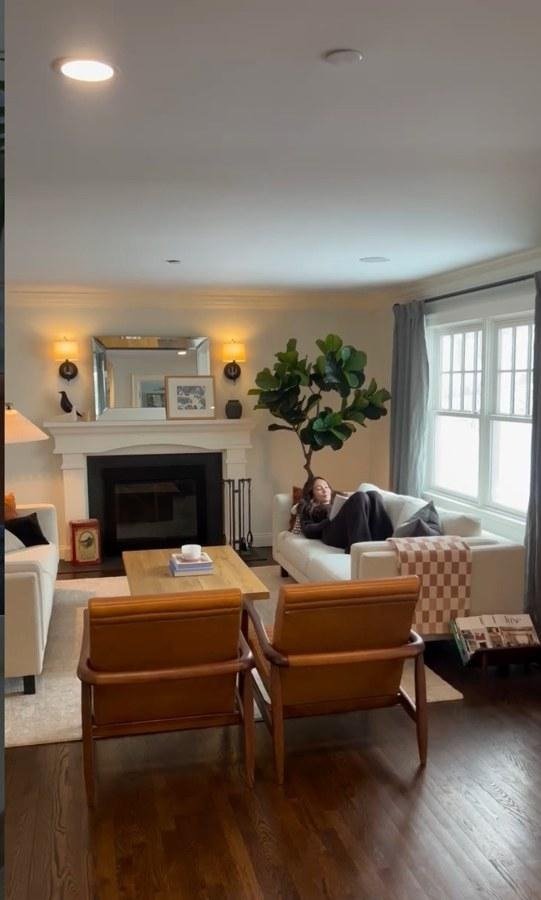
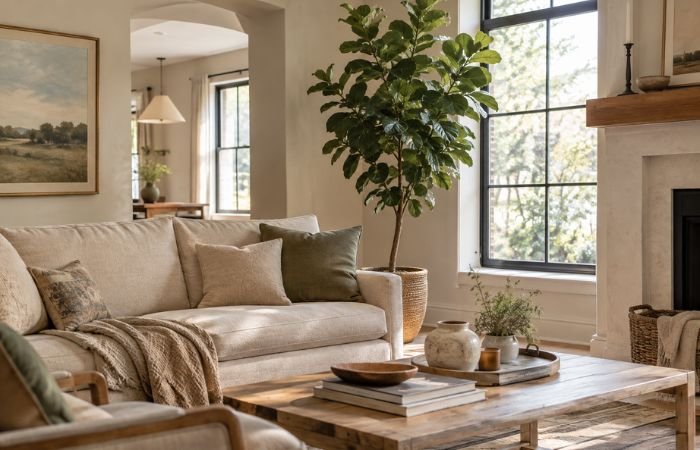
A real customer’s living room — a well-worn couch, a stack of books, someone actually curled up reading. The faux fiddle-leaf fig by the window isn’t a styled showpiece; it’s just part of the room, which is precisely the point.
Greenery has always been one of the fastest ways to make a space feel alive. The trouble has been that “alive” also means “needs attention,” often more than people realize when they bring a plant home. A growing number of homeowners are solving this not by giving up on greenery, but by rethinking what it needs to look like to work in a real, busy household.
The Maintenance Problem Nobody Budgets For
A new houseplant rarely comes with an honest account of what it will actually demand. Watering is only the beginning:
- Light requirements are specific and unforgiving. A plant rated for “bright indirect light” can decline within weeks in a room that gets less than expected.
- Seasonal changes shift the rules. The watering routine that worked in summer often overwaters a plant in winter, when growth slows and soil stays wet longer.
- Pests and disease arrive quietly. Spider mites, root rot, and fungus gnats are common enough that most experienced plant owners have a story about losing something they liked.
- Travel is a liability. A week away can be the difference between a full, healthy plant and a droopy one that never fully recovers.
None of this makes anyone a bad plant parent. It’s simply a real time cost that a lot of decorating articles skip past.
Rethinking What “Low-Maintenance” Actually Means
For years, “low-maintenance plant” meant succulents, pothos, or snake plants — genuinely easier options, but still living things with real requirements and real limits on size and placement. They solve part of the problem, not all of it.
The more complete answer for many rooms has turned out to be well-made faux greenery, and the reason is straightforward: it removes the maintenance question rather than minimizing it.
What to Look For If You Go This Route
Not all artificial trees are equal, and the difference is obvious up close. A few things separate a convincing tree from an obviously fake one:
- Trunk detail. Real bark has grain, color variation, and slight irregularities. A smooth, uniform trunk is the fastest tell.
- Leaf placement and density. Leaves attached individually to flexible stems move and catch light differently than a molded, one-piece canopy.
- True-to-life scale. A tree that’s proportioned for the room, rather than a small tabletop version, reads as intentional rather than decorative filler.
- A planter that matches the space. Trees that arrive pre-potted in a planter suited to the room save an extra shopping trip and avoid a mismatched pot undercutting the effect.
Companies such as Rootless Plants have leaned specifically into this level of detail, building trees at true room-filling heights with hand-finished bark and individually placed foliage, arriving pre-potted and ready to place rather than assembled from a box.
Where This Actually Solves a Problem
This approach isn’t about avoiding real plants altogether — it’s about matching the solution to the situation. A few scenarios where it consistently makes sense:
Frequent Travelers
If a household is regularly away for a week or more, no watering schedule fully accounts for it. A tree that needs nothing removes the risk entirely.
Difficult Light Conditions
Interior rooms, hallways, and north-facing spaces are genuinely hard for live plants. Rather than settling for an empty corner, a well-made faux tree can go where a real one structurally can’t.
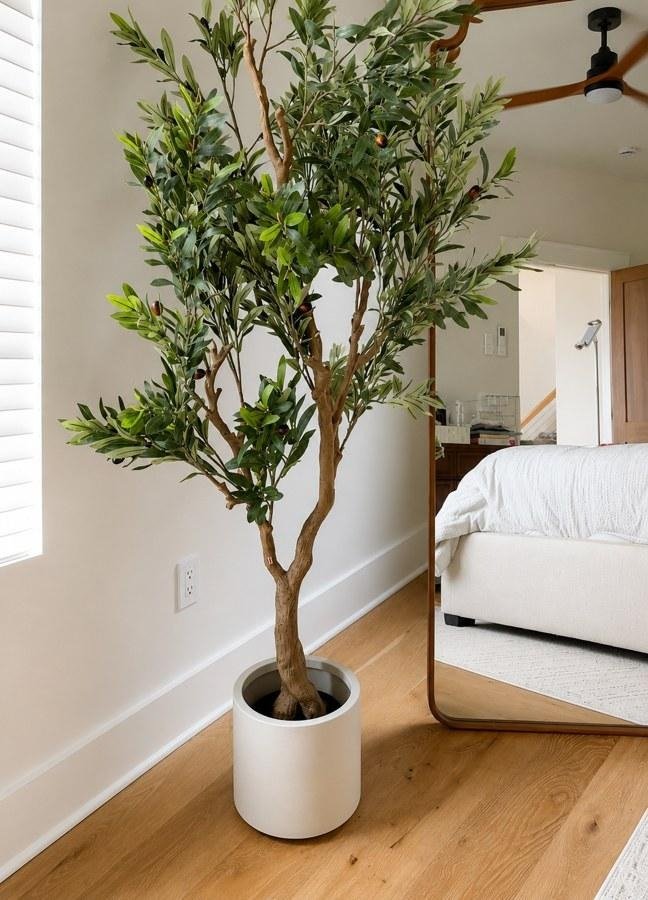
A faux olive tree holding down a bedroom corner — caught here in the reflection of a dressing mirror. Bedrooms are a common trouble spot for real plants, between inconsistent light and the risk of forgetting to water something that’s easy to overlook at the end of a long day.
Households Without Time to Spare
Between work, family, and everything else competing for attention, plant care is often the first thing to slide. That’s not a failure of intention — it’s a scheduling reality that a low-maintenance option is built to accommodate.
The Jungle Look, Without the Jungle-Sized Time Commitment
There’s also a maximalist version of this problem worth mentioning. The “jungle lush” look — rooms packed with dense, layered greenery — has been a strong biophilic design trend for a few years now, and it’s genuinely striking when it works. It’s also expensive to build with real plants and even harder to maintain, since a dozen plants means a dozen different light and watering needs happening at once in the same room.
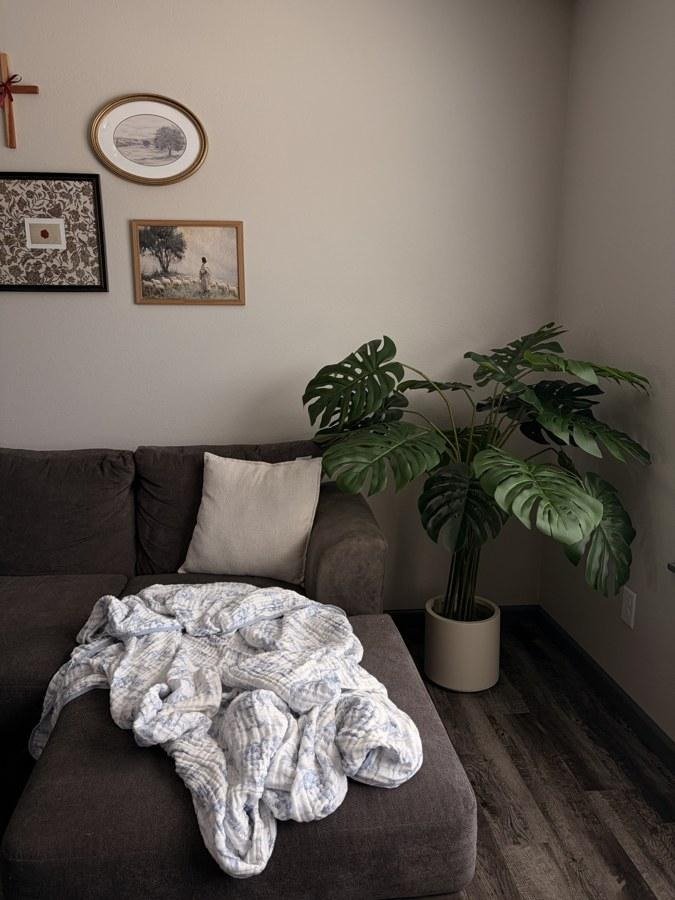
A faux monstera tucked into the corner of a real, lived-in living room. Its bold, sculptural leaves do a lot of the “jungle” visual work on their own — the kind of statement plant that anchors a biophilic mix without adding to the maintenance list.
The workaround several designers have landed on is a blended approach rather than an all-or-nothing choice: fill most of the volume with realistic faux trees and greenery, then layer in a smaller number of real plants — often cited at around a 70/30 split in favor of faux — for the ones that are easiest to keep thriving, like a pothos or a snake plant. The result reads as fully alive from across the room, while concentrating the actual maintenance down to a handful of forgiving plants instead of a dozen demanding ones.
Making the Switch Without It Looking Like a Compromise
For anyone considering this route for the first time, a few practical habits help avoid the most common missteps:
- Start with one high-visibility spot. A living room corner or entryway is a better test case than filling an entire home at once — something like a Sacred Ficus tends to work well as a first piece — and it’s where the design payoff is most noticeable.
- Match the tree’s scale to the room, not the doorway. A common mistake is buying smaller to make delivery or placement easier; an undersized tree tends to look like an afterthought rather than a feature.
- Dust occasionally. The one piece of “maintenance” that remains — a soft cloth or duster every few weeks keeps leaves looking crisp rather than flat.
- Resist the urge to over-explain it. The best-made faux trees don’t need a disclaimer, and pointing one out to guests usually only works against the effect.
None of this requires special skill or a big time investment — which is, after all, the entire point of choosing this option in the first place.
A More Honest Way to Decorate With Greenery
The goal isn’t to declare real plants obsolete — plenty of people genuinely enjoy the process of caring for them, and that enjoyment is worth keeping if it’s there. But decorating advice too often treats greenery as a one-size-fits-all recommendation, without acknowledging that upkeep is a real cost some households can’t or don’t want to pay.
Choosing a realistic, well-made alternative for the rooms that need it isn’t cutting corners. It’s decorating for the life you actually have, not the one a plant care guide assumes you do.