
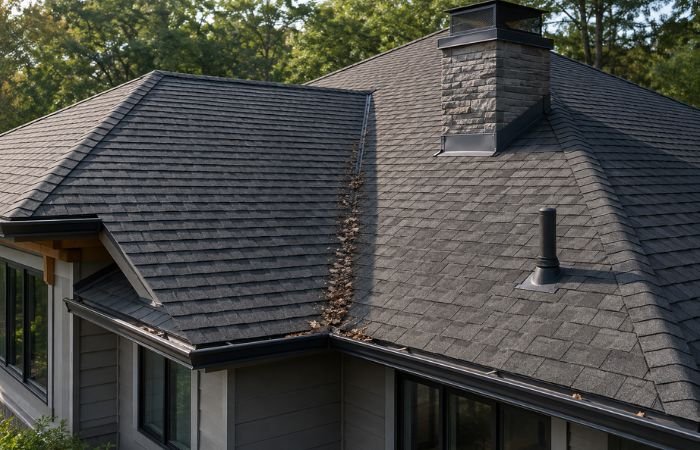
The broad, open sections of a roof usually look like the most important areas because they cover most of the house. Yet roofing problems often deserve especially close attention where the surface changes direction, reaches an edge, or meets another component.
Valleys collect runoff from multiple slopes. Vents and chimneys create openings through the roof. Eaves and other edges deal with water leaving the surface. These locations depend on careful material placement and detailing because water does not simply travel across them in a straight line.
Understanding why these areas are different can help homeowners recognize where roof inspections and repairs often require extra care.
Roof Valleys Handle Concentrated Water Flow
A valley forms where two roof slopes meet and direct water toward the same channel.
During rainfall, water from both slopes moves into this relatively narrow area before continuing toward the roof edge. Leaves, twigs, and other debris may also collect there more easily than on open slopes.
Because valleys manage concentrated runoff, the materials and installation in these areas must direct water without allowing it beneath the roof covering.
Debris Can Change How Water Moves
Leaves and organic material can slow drainage when they build up in a valley.
Water may then spread differently across the surface or remain in contact with roofing materials longer than it normally would. Debris can also make it harder to see damaged materials underneath.
Keeping valleys clear provides a better view of their condition and allows runoff to follow the intended path.
Flashing Protects Many Roof Transitions
A roof becomes more complicated anywhere the main covering meets another surface.
Walls, chimneys, skylights, vents, and other penetrations create joints that cannot be protected by the field roofing alone. Flashing is commonly used to direct water around these transitions.
The exact detail depends on the location and roof design.
A Professional roofing supplier can help contractors obtain flashing, underlayment, ventilation components, and other materials suited to the roofing system being installed. Shunde, for example, lists flashing and multiple supporting roof products alongside its primary roofing materials.
The key is to treat these smaller components as part of the roof rather than accessories selected after the main materials are already on site.
Roof Penetrations Interrupt the Main Surface
Plumbing vents, exhaust vents, chimneys, and skylights all require openings in a roof.
Every opening creates edges where the roof covering must connect with another component. These connections need to continue directing water toward the lower roof edge rather than allowing it into the opening.
Sealant Alone Should Not Be the Whole Plan
Homeowners may sometimes notice sealant around an older vent or similar roof feature and assume adding more will solve any moisture concern.
Sealants can have specific roofing uses, but roof penetrations generally depend on correctly installed components and flashing details rather than a thick layer of material covering the joint.
If water appears near a penetration, finding out why the detail is failing is more useful than repeatedly covering the visible area.
Chimneys Create Several Different Water Paths
Chimneys are particularly interesting because they interrupt the roof on multiple sides.
Water approaching the upper side of a chimney must move around it. The side sections need to continue that movement, while the lower section must direct runoff back onto the roof.
That creates several transitions within a small area.
Changes in materials also matter. Masonry and roofing components are different surfaces, so the connection between them deserves inspection when moisture appears nearby.
A ceiling stain close to a chimney may therefore require more investigation than simply examining the nearest shingles.
Roof Edges Deal With Water Leaving the Surface
Once water travels down a roof, it eventually reaches the eaves or another drainage point.
These edges connect roofing materials with components such as gutters, fascia, and other exterior details. If water does not leave the roof as intended, nearby materials may receive repeated exposure.
Clogged gutters can make the situation more noticeable by allowing water to spill over instead of moving through the downspouts.
Look for Changes Along Fascia and Soffits
Staining, peeling finishes, or deterioration near roof edges can provide clues that water movement deserves attention.
These symptoms do not automatically prove the roof covering is the source. Gutter problems, flashing details, or other exterior conditions may also be involved.
Looking at the entire edge rather than one material can make the source easier to identify.
Intersections With Walls Need Careful Detailing
Some roofs terminate against vertical walls instead of continuing to an open edge.
This happens around additions, dormers, upper stories, and other architectural features. Water running down the roof reaches the point where two different surfaces meet.
That joint must move water away without allowing it behind the exterior covering or beneath the roofing material.
Because these areas involve several building components, a quality roofing company may inspect shingles, flashing, wall transitions, and nearby drainage rather than treating a suspected leak as a problem with one material alone. Slavin lists flashing, valleys, leaks, and damaged shingles among the conditions addressed through its roofing services.
Skylights Require Attention on Every Side
A skylight creates another opening within the roof surface.
Water reaches its upper edge, moves along both sides, and continues past the lower edge. That makes the surrounding flashing and roofing arrangement important.
Interior staining around a skylight can have several possible causes, so the visible location of moisture should be treated as a clue rather than a final diagnosis.
A close inspection can determine whether the concern comes from surrounding roofing details, the skylight itself, or another source.
Changes in Roof Shape Create More Details
Simple roofs generally contain fewer transitions than roofs with several dormers, valleys, additions, and intersecting slopes.
Architectural complexity is not automatically a problem. It simply creates more locations where water must change direction or move around an obstacle.
That means detailed roofs benefit from careful inspection of connections, not only large shingle areas.
Homeowners viewing the roof from the yard may see an uninterrupted finished surface while several different water-management details are working underneath and around it.
Repairs Should Address the Cause, Not Just the Wet Spot
A leak showing inside the house does not necessarily sit directly below the place where water entered.
Water may move along decking or framing before becoming visible on a ceiling or wall. This is particularly relevant around valleys, penetrations, and complex roof intersections.
Following the moisture path can help identify the real entry point.
Replacing a damaged interior finish without correcting that source leaves the conditions that caused the problem unchanged.
Small Roof Areas Can Carry Big Responsibilities
Open roof surfaces handle a large amount of weather exposure, but valleys, edges, penetrations, and wall intersections have more complicated jobs.
They collect water, redirect it, carry it around openings, or move it from one building surface to another. Their performance depends on the relationship between roofing materials, flashing, drainage, and careful installation.
For homeowners, that means roof condition should not be judged only by looking for missing shingles across the largest visible areas. The smaller transitions deserve attention too. A roof performs as one connected system, and the places where its components meet can reveal problems long before the broad surface looks seriously damaged.


