
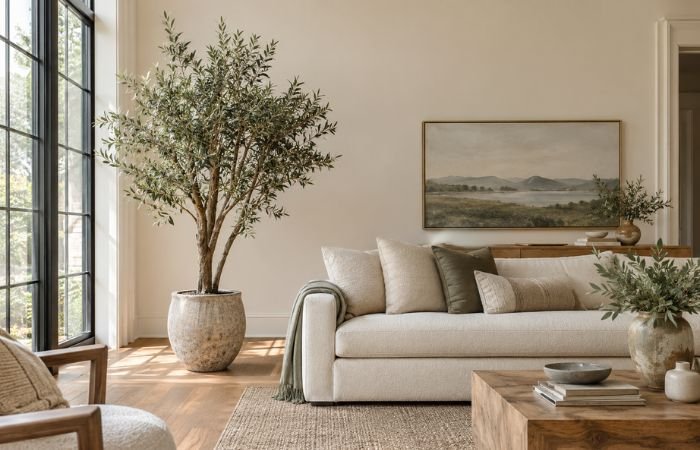
There was a time when “fake plants” meant one thing: a dusty ficus in the corner of a dentist’s waiting room, its plastic leaves catching fluorescent light in all the wrong ways. That association has aged out. Walk through a design-forward hotel lobby, a boutique office, or a friend’s newly renovated living room today, and there’s a good chance the six-foot olive tree anchoring the space isn’t real — and you’d never know it.
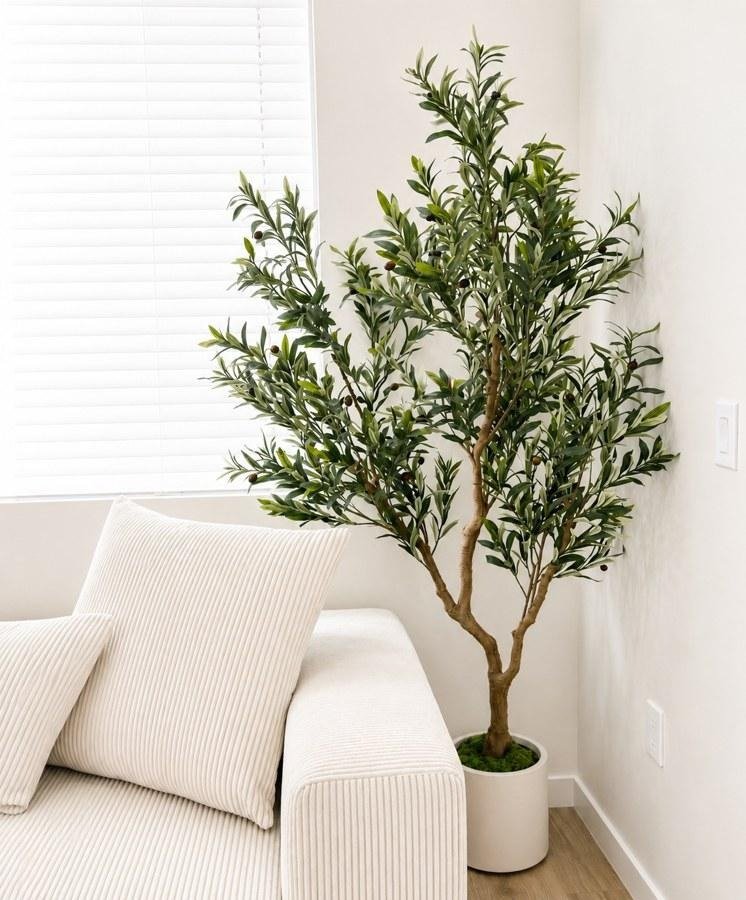
This is exactly the kind of moment that’s changed people’s minds about faux greenery — a tree tucked beside the sofa, doing nothing more than looking like it belongs there. Nothing about it announces itself as faux; it simply reads as a well-placed piece of the room.
This shift isn’t a passing trend. Faux greenery has quietly become one of the fastest-growing categories in home décor, and it reflects a broader change in how people think about greenery at home: less as a living responsibility, more as a design element that should simply look right, all year, without negotiation.
Why Real Plants Are Losing Ground Indoors
Live indoor trees are notoriously particular. They need consistent light, the right humidity, and a watering schedule that most households simply don’t maintain. A fiddle-leaf fig can drop leaves after a single missed feeding. A drafty window can stall a olive tree’s growth for a season.
For renters, frequent movers, or anyone without reliably bright rooms, the odds are stacked against success. Design blogs are full of advice on saving a dying houseplant; far fewer discuss how to avoid the problem altogether.
That’s the gap high-end faux greenery has quietly filled.
What Changed: Materials, Not Just Marketing
The leap in quality over the last several years has been driven by manufacturing, not clever styling photography. Four shifts stand out:
- Bark texture is now hand-finished. Older faux trunks were smooth, printed sleeves over plastic cores. Newer ones replicate the ridges, grain, and color variation of real bark closely enough to withstand a curious touch.
- Foliage is built leaf by leaf. Individually placed leaves on articulated stems catch light and shift with air movement, instead of sitting as a static, uniform canopy.
- Materials are built to last, not just to look good on day one. UV-stabilized foliage that resists fading or yellowing near a sunny window, paired with sturdier, more durable construction overall, has become a baseline expectation rather than a premium add-on.
- Stems and branches now hold a shape. Bendable wire-core stems let a tree’s foliage be fanned, angled, and adjusted after it arrives, so a canopy settles into an asymmetric, lived-in silhouette instead of a stiff, factory-uniform one.
- Scale finally matches real rooms. A significant complaint with older faux trees was size — most topped out around three feet, better suited to a tabletop than a living room corner. Full-height options in the five- to seven-foot range now fill space the way an actual tree would.
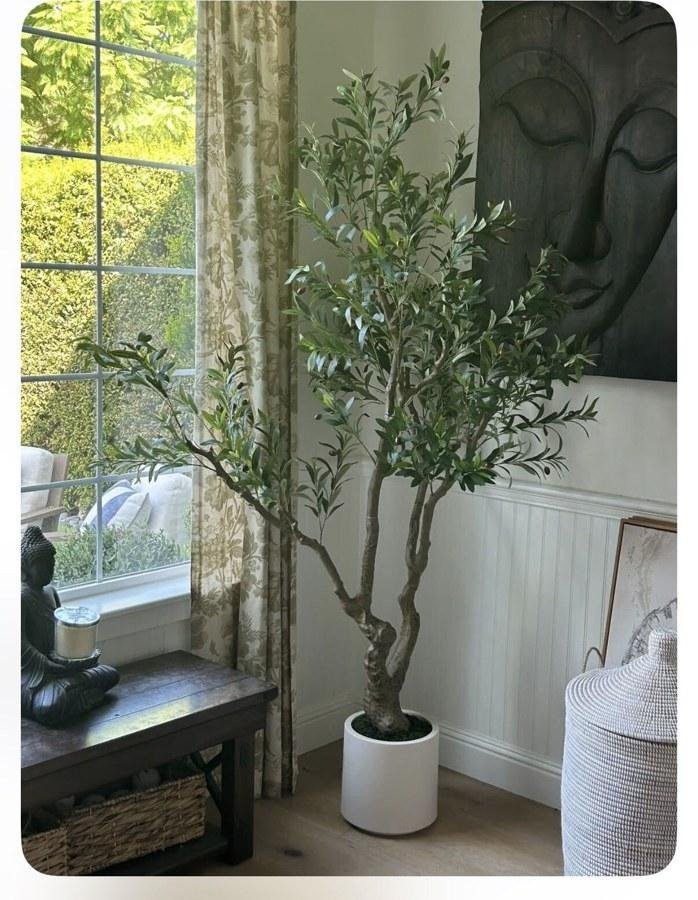
This close-up, taken by a customer styling their tree beside a carved wood statue, shows exactly what that hand-finished bark looks like up close — the kind of gnarled, irregular trunk detail that used to be the giveaway separating a faux tree from a real one.
A handful of brands have pushed this last generation of realism further than most, and Rootless Plants is a clear example — building trees at true room-filling heights with hand-finished bark and individually placed foliage, arriving pre-potted and ready to place rather than assembled from a box.
Which Trees Are Leading the Category
Not every species has made the jump to faux equally well. The trees driving most of this growth fall into two camps.
The classics remain the reliable choice: a broad-canopied olive tree or a stately banyan reads as timeless in almost any interior, faux or real, and they’re usually the safest first purchase for someone testing the category.
The more interesting shift has been toward exotic statement pieces. Dense, dark-foliaged trees modeled on ironwood species, and tropical banana trees with their broad, glossy leaves, have moved from novelty to genuine design leap — the kind of piece that changes the character of a room rather than simply filling a corner. Brands offering this range, Rootless Plants included, have also leaned into bendable bark and stems on ficus and monstera trees, which let each leaf and branch settle at a slightly different angle. It’s a small detail, but it’s often the one that gives a tree away as convincingly natural rather than mass-produced.
The Design Case, Not Just the Convenience Case
It would be easy to frame faux trees purely as a maintenance shortcut, but interior designers increasingly treat them as a legitimate material choice, on par with selecting the right rug or lighting fixture.
A few reasons this holds up:
- Predictability. A designed space depends on elements staying where they’re put. A living tree grows, leans toward light, and eventually outgrows its spot; a faux tree looks the same on day one and year three.
- Styling flexibility. Because there’s no need to consider light exposure, a striking tree can anchor a dim hallway, a windowless office corner, or a stairwell landing — locations where a real plant would slowly decline.
- Consistency across multiple units. For hospitality and commercial projects, matching greenery across dozens of rooms with live plants is close to impossible. Faux trees solve this outright.
Where It Makes the Most Sense
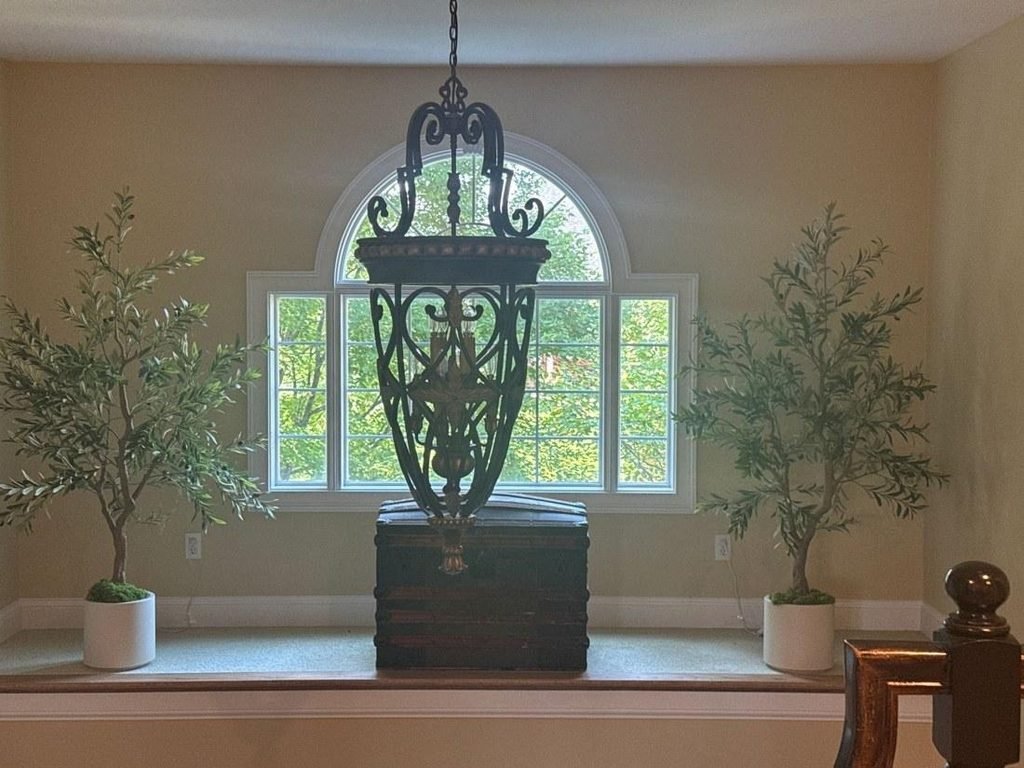
A real customer’s foyer, using a matched pair of faux olive trees to frame an arched window. Symmetry like this is hard to pull off with live plants — no two real trees grow at the same rate, so the pair would drift out of balance within a season. With faux, the match holds indefinitely, which is exactly why designers reach for it in formal, symmetrical layouts like an entryway or a stair landing.
Not every space benefits equally. Faux greenery tends to perform best in:
Low-Light or High-Traffic Rooms
Entryways, hallways, and north-facing rooms are difficult environments for real plants and ideal candidates for a realistic faux tree instead.
Rentals and Frequent Moves
Anyone who doesn’t control the building’s lighting or plans to move within a few years benefits from greenery that survives the moving truck as easily as it survives a windowless apartment.
Commercial and Hospitality Settings
Offices, showrooms, and short-term rentals need spaces to look finished on day one, with no ramp-up period and no risk of a wilting centerpiece before an important walkthrough.
What to Check Before Buying
Because the category has grown so quickly, quality varies enormously between one faux tree and another, often at similar price points. Marketplaces like Amazon are flooded with options, and a meaningful share of them are exactly what the price suggests — thin foliage, a flat plastic trunk, and a tree that looks convincing only in a product photo. If a piece is going to anchor a room for years, it’s worth treating the purchase with the same scrutiny as a piece of furniture rather than an impulse buy.
A few details are worth checking before committing to one for a prominent spot in a room:
- Trunk material and finish. Ask (or look closely) whether the trunk is a single molded piece or built up with texture and color variation by hand. This is usually the first thing a visitor notices, even if they can’t say why something looks slightly off.
- Foliage attachment. Leaves fixed individually on wire stems allow natural movement and a less uniform silhouette than leaves molded in fixed clusters.
- Included planter quality. A tree that ships in a flimsy or mismatched pot undercuts the overall effect immediately; a solid, well-proportioned planter finishes the look on arrival.
- Warranty length and terms. Given that these pieces are meant to last for years rather than a season, a substantial warranty is a meaningful signal. Rootless Plants, for instance, backs its trees with a 3-year warranty — the kind of coverage a company generally only offers when it’s confident the materials will hold up.
Treating the purchase this way tends to produce far better long-term results than chasing the lowest listed price.
A Small Shift With a Real Design Payoff
None of this suggests real plants are on their way out — a thriving monstera or a well-tended fern still brings something a faux version can’t fully replicate. But the binary of “real plant or empty corner” no longer holds. For the rooms that have always struggled to support living greenery, today’s best faux trees offer a credible third option: one that looks intentional, holds up under scrutiny, and never asks for anything in return.
That’s a quieter kind of design win, but for anyone who has replaced the same dying plant three times in as many years, it’s not a small one.


