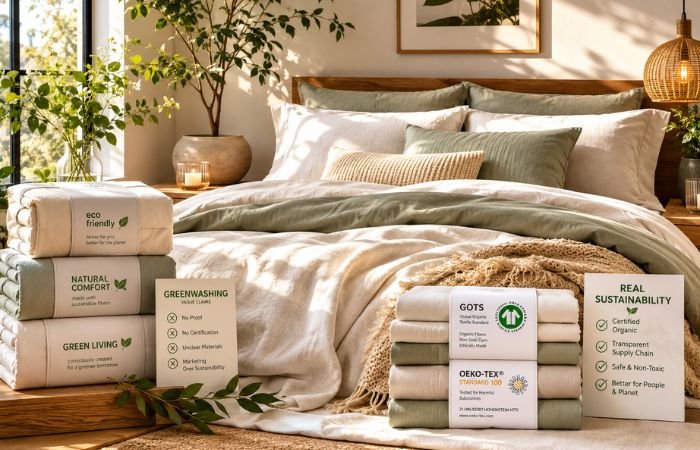
Walk down any bedding aisle, or scroll through any sheet brand’s homepage, and you’ll see the same words on repeat: eco-friendly, natural, sustainable, organic. Green leaves on the packaging. Beige color palettes. Photos of cotton fields at sunrise.
The bedding industry has figured out that sustainability sells. What it hasn’t figured out, in many cases, is how to back those claims up. The result is a category where genuinely responsible products sit on the same shelf as products wearing a green costume, and the packaging looks almost identical.
The good news: greenwashed bedding is surprisingly easy to spot once you know which label tricks to ignore. Here’s what to look past, and what to look for instead, the next time you’re shopping for sheets, duvet covers, or pillowcases.
Why Bedding Is a Greenwashing Hotspot
Most people replace their sheets every few years at most. That infrequency works in marketers’ favor: shoppers never build the label literacy they have with groceries, where they buy weekly and learn quickly which claims mean something.
Add to that the fact that terms like “eco-friendly,” “green,” and “natural” have no legal definition on textiles, and you get a category where vague claims flourish. The Federal Trade Commission’s Green Guides technically prohibit deceptive environmental marketing, but enforcement actions are rare. In practice, the job of separating substance from styling falls on you.
Five Label Tricks to Ignore
1. “Eco-Friendly” and “Sustainable” With Nothing Behind Them
These are feel-good adjectives, not standards. No regulator checks whether a sheet set labeled “sustainable” was made sustainably, and no test exists that a product must pass to earn the word.
The tell is specificity. A trustworthy brand attaches the claim to a verifiable fact: the fiber used, the dye process, the factory’s water treatment, a named certification. If the most specific thing a brand can say about its sustainability is the word “sustainable,” treat it as decoration.
2. The Bamboo Sleight of Hand
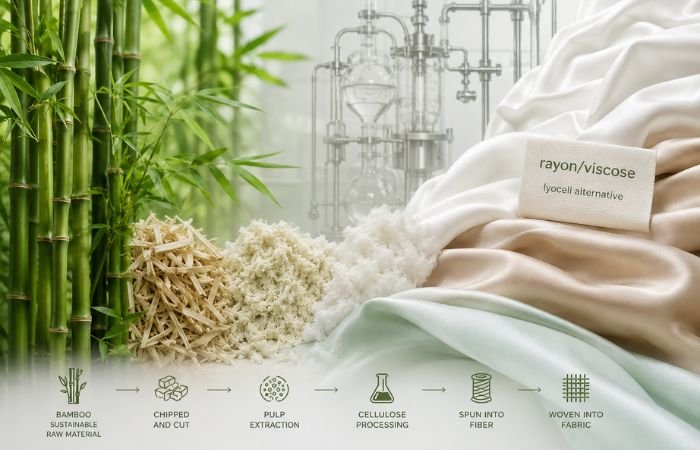
“Bamboo sheets” sound like something woven from a fast-growing grass. In reality, almost all of them are rayon (also called viscose): bamboo pulp dissolved in chemical solvents, then extruded into fiber. The plant may grow with little water and no pesticides, but the conventional viscose process is chemically intensive enough that the FTC has fined major retailers for marketing rayon as “bamboo.”
None of this means bamboo-derived fabric feels bad; plenty of people love its silky drape. It means “bamboo equals natural and green” is mostly marketing. If you want a plant-pulp fiber with cleaner processing, look for lyocell, which is produced in a closed-loop system that recaptures its solvents.
3. The “Made With Organic Cotton” Percentage Game
“Made with organic cotton” can legally describe a product that is only partly organic, blended with conventional cotton or polyester. The phrase rides the halo of the word “organic” without committing to a number.
Look for the percentage, and look for a certification that covers the finished product rather than just the raw fiber. The Global Organic Textile Standard (GOTS), for instance, requires at least 70 percent certified organic fiber for its “made with organic” label and 95 percent for its full “organic” label, and it audits the processing stages too. A bare “made with organic cotton” with no number and no certifier is a claim built to be unverifiable.
4. Green Packaging and Invented Badges
Kraft-paper boxes, leaf icons, hand-drawn seals reading “Earth Conscious Promise” or “Green Certified Quality.” Visual greenwashing is the cheapest kind, because imagery makes no claim a lawyer has to defend.
Self-awarded badges are the trick to watch for. They’re designed to look like third-party certifications at a glance. The difference: a real certification names the standard (GOTS, OEKO-TEX, Fair Trade) and carries a license or certificate number you can look up in the certifier’s public database. An invented badge names a feeling.
5. “Non-Toxic,” “Chemical-Free,” and “All-Natural”
Nothing made of matter is chemical-free, and “non-toxic” has no defined threshold on textiles. These phrases exist to soothe, not to inform.
The verifiable version of this claim is OEKO-TEX Standard 100: the finished textile, including thread, buttons, and dyes, has been laboratory-tested against published limits for hundreds of harmful substances. A brand that has actually done the testing will say so by name. A brand that hasn’t will say “non-toxic.”
The Labels That Actually Mean Something
Three certifications do the heavy lifting in bedding, and they answer different questions:
- GOTS — covers organic fiber content plus environmental and labor standards through every processing stage, from field to finished sheet.
- OEKO-TEX Standard 100 — tests the finished product for harmful substances. It says nothing about farming or wages; it answers “is this safe to sleep on?”
- Fair Trade — focuses on labor conditions and pay for the people making the product.
One habit beats everything else: verify the certificate. Both GOTS and OEKO-TEX maintain public databases where you can enter a license number and confirm it’s real and current. Brands that have done the work tend to display the number proudly; brands that haven’t display only the logo.
Start With Your Sleep Problem, Not the Label
Greenwashing works because it sells an identity, the kind of person who buys eco things, rather than a function. The easiest way to be immune to it is to flip the order: decide what your bedding needs to do first, then apply the certification filter to the options that qualify.
If you sleep hot or wake up drenched, breathability and moisture handling matter far more than any badge on the box, and the fiber-and-weave details are worth understanding before you pay extra for an “eco-cooling” label. This breakdown of which sheet fabrics actually help with night sweats is a useful starting point, because the fabrics that genuinely cool you down are a short list.
The same logic applies to skin. If you’re prone to breakouts or irritation, the smoothness of the weave and how often you can wash the fabric at high temperatures matter more than the marketing. There’s a solid explanation of how your sheets and pillowcases affect breakout-prone skin that covers what dermatology actually supports, versus what labels imply.
Once you know the fiber and weave that solve your problem, the green question becomes simple: of the products that fit, which ones can prove their claims?
A 30-Second Pre-Purchase Checklist
Before you click “buy,” run through these:
- Is the green claim specific (fiber, process, standard) or just an adjective?
- Is there a named certification with a license number you could look up?
- If it says “bamboo,” does the fiber content label say rayon or viscose?
- If it says “organic,” is the percentage stated and certified?
- Is that badge from a third party, or did the brand draw it?
- Does the fabric actually suit your sleep needs, independent of the marketing?
The Bottom Line
Greenwashing isn’t a reason to be cynical about every sustainability claim in bedding; genuinely well-made, responsibly produced sheets exist at most price points. It’s a reason to change what you trust. Brands doing the real work make verification easy, because verification is their advantage. Trust the labels that name standards and numbers. Ignore the ones that name feelings.


