
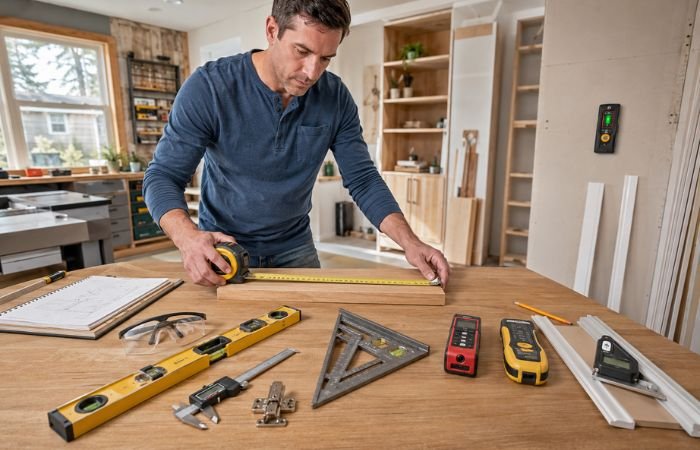
Accurate measurements are essential for successful home improvement projects. Even minor errors can result in uneven shelves, poorly fitting hardware, wasted materials, or extra trips to the hardware store. While it is tempting to rely on a single device, no one measuring tool works for every project. A tape measure may be suitable for checking room dimensions, but completely different tools are needed to confirm alignment, precisely measure small components, find hidden wall framing, or calculate unusual angles. This article covers seven useful measuring tools for decorating, repairs, furniture placement, cabinetry and general DIY work.
1. Tape Measure: The Everyday Measuring Essential
A tape measure is the most widely used measuring tool in any homeowner’s toolbox, providing the standard foundation for accurate measurements. It handles common tasks like measuring walls and rooms, planning furniture placement, checking appliance openings, sizing curtains and window treatments, measuring shelves and cabinets, and marking lumber. When selecting measuring tools for DIY work, you should consider adequate blade length, readable markings, a reliable locking mechanism, and a durable case. For reliable readings, the blade must remain straight and level; a bent or angled tape easily produces inaccurate numbers. Always measure from the exact same reference point, and confirm all important dimensions multiple times before cutting materials or purchasing furniture.
2. Spirit Level: For Straight and Balanced Installations
Measuring the correct distance does not guarantee that an item will be installed straight. For proper orientation, you must understand two structural concepts: level (horizontal) and plumb (vertical). A spirit level is essential for ensuring straight and balanced installations. It is incredibly useful for installing shelves, hanging mirrors and artwork, mounting curtain rods, positioning cabinetry, laying tile, and checking furniture and countertops. While compact levels are handy for small household projects, longer levels provide more reliable readings across wider surfaces. Rather than trusting a single reading, you should verify alignment at multiple points across a long shelf, cabinet, or surface.
3. Digital Caliper: For Small Parts and Precise Measurements
Tape measures work well for rooms, boards, and furniture, but they are not designed to accurately measure very small components. A precision tool is required to check external dimensions, internal dimensions, component depth, and material thickness. Calipers take four useful measurements: outside measurements using the larger jaws, inside measurements using the smaller jaws, depth measurements using the depth rod, and step measurements using the rear surfaces.
A tape measure may provide a rough estimate, but it cannot reliably identify the diameter, thickness, or depth of a small component. When a homeowner needs to match an unmarked screw, replace cabinet hardware, identify a drill bit, or confirm the size of a plumbing fitting, a digital caliper can provide a much more precise reading. This can help prevent purchasing incompatible parts or repeatedly returning to the hardware store.
For the best results, keep the measuring faces clean, close the jaws gently until they contact the part, apply consistent light pressure and check that the display reads zero when the jaws are fully closed. If it does not, clean the jaws and inspect the tool before using the zero function. Many digital models switch easily between imperial and metric measurements, which is especially helpful when replacement parts use different measurement systems.
4. Combination Square: For Angles and Layout Lines
A combination square is incredibly useful for checking right angles, marking straight lines, and accurately transferring measurements between materials. A typical combination square includes a graduated rule and an adjustable head with 90-degree and often 45-degree reference surfaces. Many models also include a level vial and scriber. Homeowners frequently use this tool for checking 90-degree corners, marking straight cut lines, measuring short distances, checking the depth of a groove or recess, transferring measurements, and laying out shelving, trim, or cabinetry projects. This tool is especially useful when a tape measure identifies a distance but cannot confirm whether a marked line or corner is square. For maximum accuracy, always hold the square firmly against a clean, straight reference edge when striking a layout line.
5. Laser Distance Measure: For Rooms and Larger Spaces
A laser distance measure makes it significantly faster to check room dimensions, wall lengths, and ceiling heights. The tool calculates the distance from a selected reference point on the device to the surface targeted by the laser. It is ideal for measuring rooms, planning flooring quantities, checking wall area, planning furniture layouts, or estimating paint and wallpaper coverage while working alone. A laser measure complements rather than completely replaces a tape measure—lasers excel at rapid room-scale measurements, while tape measures are usually better for marking materials before cutting. Always confirm that the laser is hitting the intended target and that the correct reference point is selected. Bright conditions, transparent or highly reflective surfaces, obstructions and an unstable measuring position can make targeting or readings less reliable.
6. Stud Finder: For Locating Support Behind Walls
A stud finder does not measure distance in the traditional sense, but it helps homeowners locate structural framing and other hidden elements before drilling into a wall. Drywall alone may not safely support heavier loads without suitable anchors or attachment to structural framing. Scan the wall slowly and mark both edges of a suspected stud before estimating its center. Take additional precautions, as some electronic models can also indicate metal or certain live electrical wiring, but their detection capabilities and depth vary. A clear reading does not guarantee that the wall contains no electrical cables, plumbing or other hazards. Always follow safe drilling practices and use appropriate wall anchors when a stud is unavailable.
7. Angle Finder: For Corners, Slopes, and Trim
Many homes contain corners and surfaces that are not perfectly square. An angle finder is a specialized tool designed to measure and transfer unusual angles. It is frequently used for cutting baseboards, installing crown molding, working around sloped ceilings, measuring stair components, building furniture, fitting trim into uneven corners, and planning miter cuts. Guessing an irregular angle often results in highly visible gaps and wasted material upon installation. Depending on the tool’s design, the measured angle can be copied onto the material or used to set the required saw angle. To ensure a tight fit, always confirm the reading twice and test complicated angled cuts on scrap material before committing to the final piece.
How to Choose the Right Measuring Tool for the Project
Use this simple project-based summary to select the appropriate tool for your needs:
- Walls, furniture, and materials: tape measure
- Horizontal and vertical alignment: spirit level
- Small components, thickness, diameter, and depth: digital caliper
- Right angles and layout lines: combination square
- Rooms and long distances: laser distance measure
- Hidden wall framing: stud finder
- Irregular corners and slopes: angle finder
Homeowners frequently need more than one tool during a single project. For example, installing a shelf requires a tape measure to position it, a stud finder to locate support, a level to align it, and a combination square to mark mounting points. Match the tool to the type and scale of measurement rather than relying on the most convenient option for every task.
Simple Habits That Improve Measurement Accuracy
Careful measurement is especially important when ordering custom materials, replacing specialized hardware, or working with limited quantities of materials.
Adopt these practical habits across all home improvement projects to ensure precise results:
- Measure twice before cutting, drilling, or ordering materials.
- Record measurements immediately rather than relying on memory.
- Label each measurement clearly.
- Use the same starting point or reference edge.
- Keep measuring surfaces and tool contact points clean.
- Check that digital tools are zeroed correctly before taking a reading.
- Keep tape measures straight and properly tensioned.
- Confirm room measurements at more than one point, because walls may not be perfectly parallel.
- Account for trim, gaps, hardware, hinges, and necessary installation clearances.
- Consider the width of a saw blade when planning cuts.
- Avoid rounding measurements too early.
- Check whether project instructions use imperial or metric units.
Build Your Measuring Toolkit Gradually
Homeowners do not need to buy every measuring tool before beginning their first DIY project. Start with a reliable tape measure, a spirit level, and a combination square. Add more specialized tools later as projects become more detailed: laser measures for renovation planning, calipers for hardware and small fittings, stud finders for heavy items, and angle finders for trim and irregular spaces. Prioritize durable, readable, and easy-to-use tools over purchasing unnecessary features.
Next Steps
Accurate DIY work is easier when the measuring tool matches the task. Distance, alignment, thickness, diameter, hidden framing, and irregular angles all require different measurement methods. Assess the projects you complete most often and gradually build a customized measuring toolkit around those exact needs. Remember to confirm important measurements before buying, cutting, drilling, or installing materials.


