
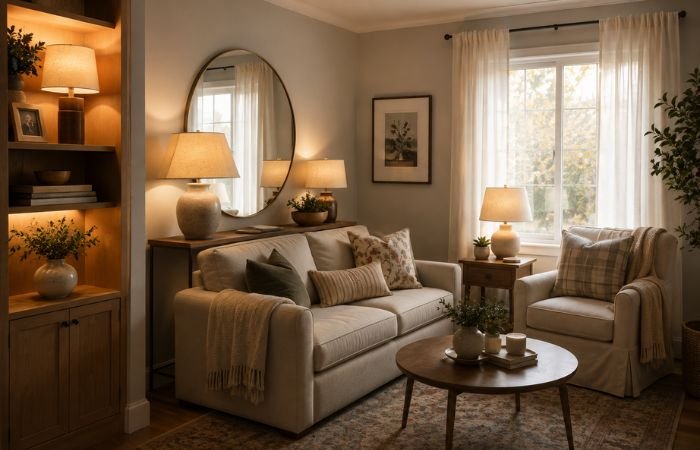
Ever notice how some small living rooms feel cozy and inviting while others just feel cramped and dark? The difference usually comes down to lighting, and more specifically, how table lamps are positioned and used.
Small spaces need smart lighting choices. You can’t rely on overhead fixtures alone because they flatten the room and make it feel smaller than it actually is. The right approach involves layering light at different heights, and that’s where table lamps become essential. A well-placed wood table lamp on a side table or console can add warmth and dimension without taking up floor space or requiring complicated installation. The key is knowing where to put them and how to make each one count when square footage is limited.
Here are five proven strategies that make small living rooms feel bigger, brighter, and more functional through smart table lamp placement.
1. Place a Lamp in the Corner to Open Up the Space
Corners tend to collect shadows in small rooms, making the entire space feel closed in. Putting a table lamp on a corner shelf or narrow console instantly pushes light into that dead zone and visually expands the room.
The light bounces off two walls at once, creating a softer, more even glow than a single directional source. This works especially well if you choose a lamp with a light-colored or translucent shade that diffuses the light rather than directing it harshly in one direction.
According to the American Lighting Association’s 2025 residential lighting survey, corner lighting increased perceived room size by an average of 18% in spaces under 200 square feet. That’s a measurable impact from a simple lamp placement.
Make sure the lamp sits on a stable surface at least 24 inches off the ground. Too low, and it won’t spread light effectively. Too high, and it creates glare at eye level when you’re seated.
2. Use Lamps to Define Separate Zones Without Walls
Small living rooms often serve multiple purposes: watching TV, reading, working from home, entertaining guests. Table lamps help you create distinct zones for each activity without physically dividing the space.
Put one lamp next to your reading chair to signal that it’s a quiet, focused area. Place another on a console behind the sofa to anchor the seating zone. This visual separation makes the room feel organized and intentional rather than cluttered.
Each lamp should serve a specific function. A reading lamp needs enough brightness for close work, typically 400 to 800 lumens. An ambient lamp for mood lighting can be softer, around 200 to 400 lumens. Mismatching brightness levels helps define different zones naturally.
Don’t line up all your lamps along one wall. Spread them across different areas so the light creates balance throughout the room.
3. Pair Lamps With Mirrors to Double the Light Output
Mirrors reflect light, and when you position a table lamp near a mirror, you effectively double its impact without adding another fixture. This trick works especially well in small living rooms where every light source needs to work harder.
Place a lamp on a console table directly below or beside a wall mirror. The reflected light fills the room more evenly and makes the space feel airier. You can also use mirrored surfaces on furniture like side tables or trays to amplify the effect.
A 2024 study from the Lighting Research Center found that strategic mirror placement increased ambient light levels by 40% to 60% compared to the same lamp setup without reflective surfaces. That’s a significant boost in a compact space.
Avoid pointing the lamp directly at the mirror if the bulb is exposed. The reflection can create uncomfortable glare. Instead, angle it slightly or use a shade that diffuses the light before it hits the reflective surface.
4. Choose the Right Table Lamp Style for Living Room Function
Not all table lamps are created equal, and small living rooms demand lamps that fit both the aesthetic and the practical needs of the space. The wrong choice takes up visual space without delivering the light quality you actually need.
When selecting a table lamp for living room use, consider the lamp’s height, shade shape, and base footprint. In a small room, you want a lamp between 18 and 24 inches tall for side tables and 24 to 30 inches for console tables. Taller lamps overpower the space. Shorter ones get lost and don’t spread light effectively.
The shade matters just as much. Drum shades with open tops and bottoms push light up and down, making ceilings feel higher and surfaces more usable. Empire shades with wider bottoms direct light downward for task lighting. Linen or fabric shades diffuse light softly, while metal or opaque shades create focused beams.
Base width is easy to overlook but critical in tight spaces. A lamp with a 6-inch base footprint leaves more usable surface area on your side table than one with a 10-inch base. That difference matters when you’re also trying to fit a coffee mug, remote, or book on the same table.
Stick to lamps that complement your existing furniture rather than competing with it. If your room has a lot of visual noise already, go for simple, streamlined lamp designs. If the space feels too plain, a lamp with an interesting texture or shape can add character without taking up physical room.
5. Layer Lamps With Adjustable Brightness for Flexibility
Small living rooms need lighting that adapts to different times of day and activities. A lamp that’s perfect for reading at 3 p.m. might feel too harsh at 9 p.m. when you’re watching a movie.
Dimmable lamps give you control without adding more fixtures. You can dial up the brightness when you need it and dial it down when you don’t. This flexibility is especially valuable in small spaces where you can’t spread out different light sources as easily as you could in a larger room.
Three-way bulbs are another option if your lamp supports them. They let you switch between low, medium, and high settings with a simple turn of the switch. You get three lamps in one without needing dimmers or smart controls.
If you’re using LED bulbs, make sure they’re compatible with your dimmer switch. Some older dimmers cause LEDs to flicker or hum. LED-compatible dimmers are affordable and easy to swap in if you’re having issues.
Practical Tips for Maximizing Table Lamp Impact
Here are three quick adjustments that make a noticeable difference in small living rooms.
- Use warm white bulbs (2700K to 3000K) instead of cool white. Warm light makes small spaces feel cozier and more inviting. Cool light can make them feel clinical or unwelcoming.
- Keep lamp shades clean. Dust blocks light output more than you’d think. Wipe shades down every couple of weeks to maintain brightness.
- Avoid matching lamp sets if your room is small. Two identical lamps can make the space feel rigid and formulaic. Mix styles or heights slightly to create visual interest without clutter.
FAQ
What size table lamp works best in a small living room?
Stick to lamps between 18 and 24 inches tall for side tables. Anything taller overwhelms the space. Console tables can handle lamps up to 30 inches if the ceiling height supports it.
How many table lamps should a small living room have?
Two to three lamps usually provide enough layered light without crowding the space. One near a seating area, one in a corner, and one on a console or side table creates balanced coverage. If your room is under 150 square feet, two lamps might be enough. You can always add a floor lamp if you need more flexibility, but table lamps should anchor the lighting layout and define specific zones without overwhelming limited surface area.
Can you use table lamps as the only light source in a living room?
Yes, but you’ll need at least three lamps placed strategically to avoid dark spots. Combine them with natural light during the day and add a floor lamp or wall sconce if the room still feels dim at night.
Do table lamps use a lot of electricity?
Not with LED bulbs. A typical LED table lamp uses 8 to 12 watts and costs around $1 to $2 per year to run for three hours daily. That’s negligible compared to older incandescent bulbs that used 60 watts or more. Switching to LEDs drops your energy use by 75% to 80% while giving you the same light output, which makes table lamps one of the most cost-effective lighting options for small spaces.
Final Thoughts on Lighting Small Spaces
Table lamps do more than light up a room. They create mood, define zones, and make small living rooms feel intentional rather than cramped. The difference between a lamp that works and one that doesn’t often comes down to placement, height, and how well it fits the specific needs of your space.
Small rooms reward smart choices. Every piece of furniture and every light source has to earn its place. When you get the lighting right, everything else falls into line. The room feels bigger, more comfortable, and more like a space you actually want to spend time in. Start with one well-placed lamp and build from there. You’ll know you’ve got it right when the room finally feels the way you always wanted it to.


