
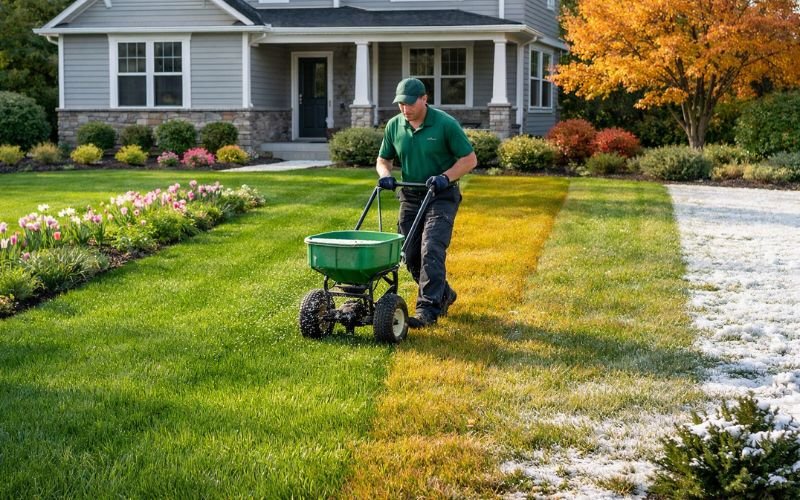
A lawn fertilizer service provides treatments for grass and soil, as fertilizers contain various nutrients used for plant growth and maintenance. The process of fertilizing stretches through the entire year, and lawns need different treatments through each season. Each stage builds upon the next to support healthy grass growth. Here is more information on lawn fertilizer stages:
Early Season Preparation
The first step in fertilizing a yard begins in early spring or fall. Fertilizers may be organic or synthetic, and each type delivers nutrients in different ways. It is key to check with service providers before choosing a product, as some fertilizers have higher nutrient concentrations than others. Performing a soil test before selecting a fertilizer will provide information on the soil’s nutrient content, including pH and nutrient levels. The choice of fertilizer will also depend on:
- Soil type
- Grass type
- Nutrient needs
- Grow rate goal
Aeration typically comes before fertilizer application; this process reduces soil compaction and helps the soil absorb nutrients more effectively. Lawn aeration is often performed in spring and fall, since extreme weather can affect soil conditions. This step is usually recommended for lawns that see heavy foot traffic.
Early steps in lawn fertilization may also involve managing seasonal weeds. Fertilizers supply nutrients that support root growth and contribute to overall grass development throughout the growing season. Some fertilizers target weeds after they’ve emerged, and others aim to prevent weed growth altogether. These fertilizers can be used alongside herbicides to better control weed growth. Lawn fertilizer services often include a fertilizer-only program if weed control is not a priority.
Mid-Season Strengthening
The next stage in the fertilization process focuses on midseason applications. At this point, fertilizers are applied to maintain nutrient levels in the soil and support grass growth during the warmer summer months. Some treatments target the root zone, providing nutrients directly to deeper layers. This period may also involve monitoring for pests and surface insects, such as chinch bugs and sod webworms, as well as addressing seasonal weeds.
Selective and broad-spectrum sprays are often used to manage both broadleaf and grassy weeds. Insect control treatments may be applied to help manage fall pests and reduce the spread of lawn diseases. Targeted care during midseason is scheduled to align with changing seasonal conditions, making sure that soil and turf treatments are applied efficiently and properly.
Late-Season Protection
Late fall marks the final stage in a year-round lawn fertilizer service process. During this period, treatments are applied to prepare the turf for winter dormancy while maintaining soil nutrient levels. Certain fertilizers are formulated specifically for the off-season, providing nutrients that focus on strengthening root systems and supporting overall soil health.
Weed and herbicide applications are also common at this stage, targeting persistent growth before the ground freezes. These treatments help maintain a controlled and balanced lawn environment throughout winter. Specialized winter fertilizers, often referred to as winterguard formulations, are used to reinforce the grassroots. They also help improve resilience against harsh winter conditions.
These applications support gradual root maintenance and prime the lawn for early spring activity once temperatures rise and snow begins to melt. By addressing both nutrient needs and seasonal maintenance, late-fall treatments provide a structured approach to lawn care. They help carry the turf through winter and set the stage for growth in the next season.
Other steps can be taken to support healthy lawn growth even in cold-climate areas. Some tips include:
- Avoid walking on frozen grass
- Remove fallen leaves
- Do not place heavy objects on the lawn
- Do not rake or shovel small amounts of snow
- Do not pile snow on the lawn when shoveling sidewalks
Get Professional Lawn Fertilizer Service
A lawn fertilizer service follows a planned schedule that includes regular feedings and maintenance. Fertilizer applications are timed to provide nutrients at different stages of grass growth, and yard care includes monitoring for pests and diseases, managing weeds, and testing soil to assess nutrient levels. Every lawn will need different treatments based on soil type, nutrient level, and typical weather. Property owners can learn more about their lawn with a soil test, and fertilizer services conduct these before suggesting a yearly program. Contact professional fertilizer service providers for more information on routine lawn maintenance services.