
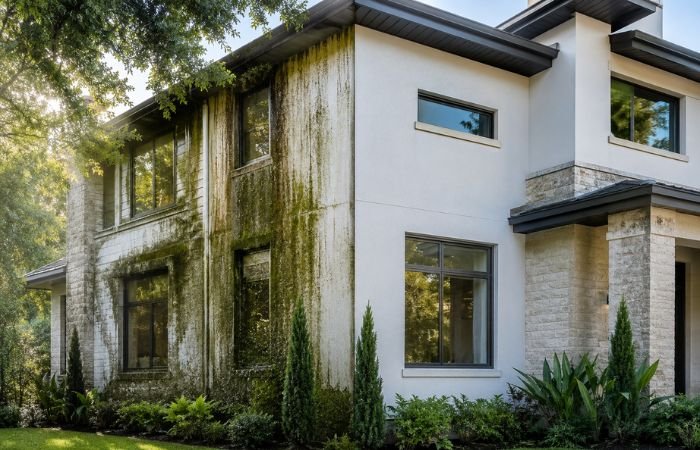
The exterior surfaces of a residential or commercial building are engineered to act as a protective barrier against weather and atmospheric stress. However, when high ambient humidity combines with airborne biological spores, exterior materials like stucco, limestone, brick, and fiber-cement siding undergo a subtle chemical and structural transformation.
What begins as light discoloration—often mistaken for simple dust or cosmetic weathering—is frequently an active, growing biological colony. Over time, these micro-organisms create a living bio-film that traps liquid moisture directly against exterior substrates. Understanding the biological mechanisms behind organic surface growth, how humidity accelerates decay, and the chemical dynamics required to safely sanitize porous building materials is essential for maintaining long-term property value and structural health.
1. The Biology of Exterior Contamination
To understand why moisture remains trapped against exterior walls, it helps to examine the specific organisms that colonize exterior substrates:
- Gloeocapsa Magma (Black Streaks): This photosynthetic cyanobacteria thrives on roofs and north-facing walls. It feeds on the calcium carbonate filler found in asphalt shingles and masonry mortars. As it grows, it secretes a dark, protective sheath that absorbs sunlight and heat, accelerating thermal degradation while holding ambient humidity against the surface.
- Green Algae and Mold Colonies: Algae spore clusters establish themselves in shaded zones where relative humidity stays elevated. Unlike simple surface dirt, green algae builds an interwoven micro-matrix that acts like a microscopic sponge, holding liquid water long after morning dew or rainfall evaporates from surrounding areas.
- Lichen and Moss Development: When algae and fungi form a symbiotic relationship, they develop into lichen. Lichen roots (rhizines) penetrate deep into the microscopic pores of concrete, brick, and limestone. As humidity fluctuates, the lichen expands and contracts, physically spalling the surface layer of the building material.
2. The Mechanics of Moisture Trapping and Material Decay
Building materials like limestone, concrete, stucco, and clay brick are naturally porous. Under ideal dry conditions, moisture that enters these porous surfaces evaporates into the surrounding air through natural vapor movement.
When a biological film covers a porous surface, it seals the outer pores shut while actively holding water underneath. This creates several structural issues:
Hydrostatic Pressure within Substrates
As trapped water expands and contracts during daily temperature changes, it builds internal hydrostatic pressure within the masonry or stucco matrix. Over time, this pressure causes hairline cracking, surface flaking, and mortar degradation.
Accelerated Organic Decay
Trapped moisture creates an ideal breeding ground for deeper fungal colonies. In regions like San Antonio, TX, where warm temperatures and high humidity persist throughout long stretches of the year, untreated organic growth can double its surface coverage in just a few weeks. The combination of heat and trapped moisture speeds up chemical breakdown in wood trim, composite decking, and painted surfaces.
3. Surface Engineering Matrix: High-PSI Blasting vs. Chemical Soft Washing
Removing organic growth requires a precise balance between physical force and chemical neutralization. Relying purely on high-pressure water blasting often damages delicate building materials while leaving microscopic fungal roots intact deep within the surface pores.
| Cleaning & Sanitation Parameter | Standard High-Pressure Blasting (High PSI) | Specialized Low-Pressure Soft Washing |
|---|---|---|
| Primary Mechanism | High physical force (2,500 to 4,000+ PSI) designed to scour the surface clean. | Targeted Chemistry: Uses biodegradable surface-active agents to neutralize spores at the root level. |
| Substrate Risk Profile | High Risk: Can etch concrete, crack aged stucco, strip protective paint layers, and force water behind siding. | Minimal Stress: Operates below 300 PSI (similar to a standard garden hose nozzle), protecting surface integrity. |
| Spores & Root Elimination | Only removes top-level growth; leaves deep microscopic spores alive inside material pores. | 100% Spore Neutralization: Completely sanitizes the surface, preventing rapid regrowth for long periods. |
| Water Intrusion Factor | High mechanical force can drive water past window seals, flashing, and wall weep holes. | Controlled, low-pressure application that flows gently across exterior drainage channels. |
4. Why Professional Surface Sanitation Outperforms Casual Washing
In high-humidity environments, addressing organic growth is a matter of chemical sanitation rather than simple pressure scrubbing. Simply spraying a surface with plain water may temporarily knock off visible dirt, but it leaves the living spore network hydrated and active inside the material’s pores. Within a short time, the bio-film returns even thicker than before.
Partnering with certified pressure washing experts ensures that your property’s specific building materials are treated with custom-blended, eco-friendly biocide solutions. These specialized formulations break down the protective lipid membranes of algae, mold, and bacteria at the molecular level. Once sanitized, the surface is thoroughly rinsed with low-pressure water, restoring the material’s natural breathability and ensuring long-lasting defense against humidity-driven biological growth.
Conclusion: Protecting Your Property’s Envelope
The exterior walls, roofs, and hardscapes of your property are continuous investments that require proactive structural care. Allowing algae, cyanobacteria, and mold colonies to establish biological footholds traps moisture directly against your building materials, leading to unseen decay, cracked stucco, and premature wear. By understanding the science of organic growth and choosing targeted, low-pressure soft-washing techniques, you eliminate biological threats at the root, safeguard your structural foundation, and keep your property looking pristine for years to come.


